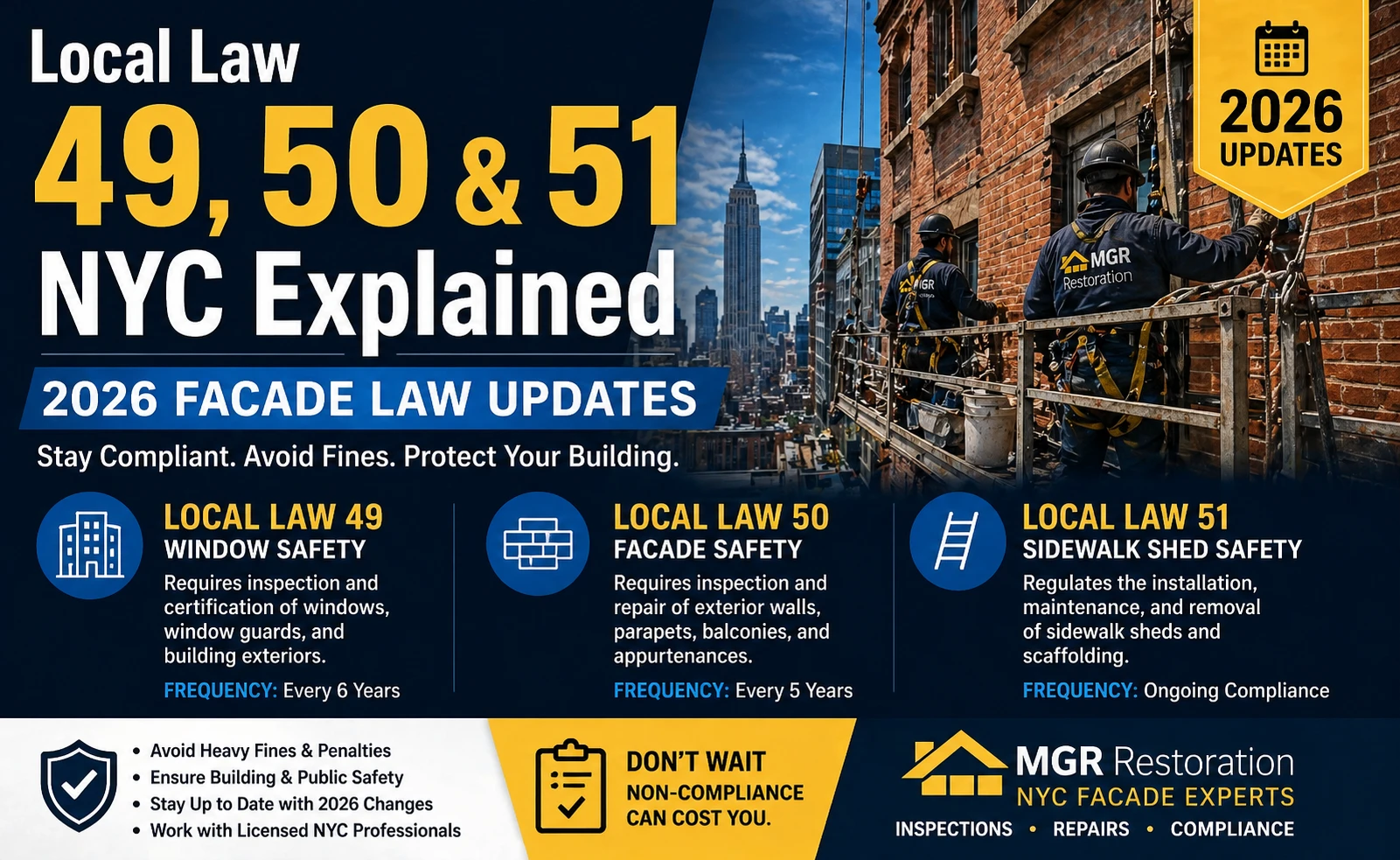
If you own a building in New York City that’s six stories or taller, the rules just changed. In 2025, the NYC City Council passed a wave of new legislation — including Local Laws 49, 50, and 51 — that directly affects how you inspect your facade, how long you can leave a sidewalk shed up, and how much you’ll be fined if you don’t move quickly on repairs.
These laws are part of the city’s “Get Sheds Down” initiative, designed to remove the thousands of long-standing sidewalk sheds across Manhattan, Brooklyn, Queens, The Bronx, and Staten Island. For NYC building owners, that means stricter timelines, bigger penalties, and a new urgency around facade maintenance.
Here’s what each law does and what it means for your New York City building in 2026.
Local Law 49 of 2025: The FISP Inspection Cycle Is Changing
For 45 years, every NYC building over six stories has had to inspect its facade every five years under the Façade Inspection & Safety Program (FISP). Local Law 49 of 2025 changes that.
What it does:
- Directs the NYC Department of Buildings (DOB) to study and revise the FISP inspection interval
- Sets the new inspection cycle to between 6 and 12 years, effective October 1, 2026
- Allows new buildings to file their first FISP report 8 years after completion (instead of 5)
What it means for NYC building owners: A longer interval sounds like good news, but it isn’t. A 6-to-12-year cycle means more deterioration accumulates between inspections, which means bigger and more expensive repairs when the next cycle comes due. Buildings that defer maintenance between cycles will face steeper bills and a higher chance of being rated Unsafe.
If you’re in Manhattan, Brooklyn, or Queens with a pre-war building, this affects you directly. The longer interval will hit older brick, terra cotta, and limestone facades the hardest. Routine masonry restoration and facade repair work between inspection cycles is now more important than ever — not less.
Local Law 50 of 2025: New Sidewalk Shed Lighting Rules
Local Law 50 amended the NYC Building Code to require brighter LED lighting under every sidewalk shed in the city. The law took effect August 15, 2025 and applies to every shed currently in place across all five boroughs.
What it does:
- Mandates upgraded LED lighting under sidewalk sheds
- Requires brighter, more uniform illumination to improve pedestrian safety
- Pairs with Local Law 47 of 2025, which raised minimum shed clearance from 8 feet to 12 feet
What it means for NYC building owners: If your building has a sidewalk shed up right now, you may need to upgrade its lighting to stay compliant. Combined with the new 12-foot minimum height, sidewalk shed installation costs in New York City are going up — likely 15–25% on new installations.
The bigger picture: every month a sidewalk shed stays in place is a month you’re paying $40–$100 per linear foot in rental fees, and now those costs are climbing. The fastest way to control your shed costs is to complete the underlying repairs and take the shed down. Our team handles full-service facade repairs and Local Law 11 remediation so your building can resolve Unsafe conditions and remove sheds as quickly as possible.
Local Law 51 of 2025: New Penalties for Slow Repairs
This is the big one. Local Law 51 of 2025 imposes serious new fines on NYC building owners who fail to complete facade repairs in a timely manner. It took effect January 12, 2026 — and it’s already being enforced.
What it does:
- Imposes penalties of $5,000 to $20,000 for owners who leave sidewalk sheds in place without taking action on the underlying facade conditions
- Sets new repair timelines once a sidewalk shed permit is issued in a public right-of-way:
- 5 months to file construction documents
- 8 months to file an acceptable work permit
- These penalties are on top of existing FISP fines (Late Filing: $1,000/month; Unsafe: $1,000+/month; SWARMP: $2,000/month)
What it means for NYC building owners: Putting up a sidewalk shed and “figuring it out later” is no longer a viable strategy in New York City. The DOB now expects active progress within months of the shed going up. Co-op boards, condo associations, and landlords across NYC need to move from inspection to repair planning to construction much faster than they used to.
This is especially urgent for buildings in high-density neighborhoods — Midtown Manhattan, Downtown Brooklyn, Long Island City, the Upper East Side, the Upper West Side, and Harlem — where pedestrian volume is high and the city is m
Local Laws 47 and 48: The Other Half of “Get Sheds Down”
While 49, 50, and 51 get the most attention, two other 2025 laws round out the package:
- Local Law 47 of 2025 — Raised minimum sidewalk shed clearance from 8 to 12 feet, expanded the approved shed color palette, and allowed containment netting as an alternative to sheds in some cases (effective August 15, 2025).
- Local Law 48 of 2025 — Limited new sidewalk shed permits to 90 days (down from up to two years). Renewals after the second permit require a Registered Design Professional to certify that work is actively underway (effective January 12, 2026).
Together with 49, 50, and 51, these laws make one thing clear: NYC has lost patience with long-standing sidewalk sheds. Every building owner, co-op board, and property manager in New York City needs a real plan to inspect, repair, and close out their facade work.
What This Means for Your Building in 2026
These five laws change the math on facade maintenance for every NYC building owner. Here’s what your building should be doing now:
1. Confirm your Cycle 10 sub-cycle and deadline.
- Sub-cycle 10A: Block numbers ending in 4, 5, 6, 9 — file by February 21, 2027
- Sub-cycle 10B: Block numbers ending in 0, 7, 8 — file by February 21, 2028
- Sub-cycle 10C: Block numbers ending in 1, 2, 3 — file by February 21, 2029
2. Address SWARMP conditions immediately. SWARMP items left unrepaired automatically reclassify to Unsafe at the next cycle. With the new Local Law 51 penalties, that’s now a $5,000–$20,000 problem on top of the existing $2,000/month fine.
3. Don’t put up a sidewalk shed until you have a repair plan. Under Local Law 48, you only have 90 days on your initial shed permit. Under Local Law 51, you have 5 months to file construction documents and 8 months for a work permit, or the fines start.
4. Maintain proactively between cycles. With Local Law 49 extending intervals to 6–12 years, between-cycle masonry restoration, waterproofing, and roofing maintenance become essential to avoid major repair bills at the next inspection.
5. Coordinate parapet, balcony, and roof inspections. Annual parapet observations (under Local Law 126) can be combined with FISP filings in years when both are due, saving coordination costs.
How NYC Building Owners Should Respond
The 2025 laws turned facade compliance from a five-year obligation into an ongoing operational responsibility. For most NYC co-op boards and condo associations, that means working with a single experienced contractor who can handle the full lifecycle — inspection, planning, permits, repairs, and shed removal — without bouncing between vendors.
At MGR Restoration, we provide the full range of services NYC buildings need to stay compliant and shed-free in 2026:
- Local Law 11 / FISP Repairs — Cycle 10 inspections, SWARMP remediation, and Unsafe repair execution across all five boroughs
- Facade Repairs — Brick, terra cotta, limestone, and concrete restoration for pre-war and modern NYC buildings
- Masonry Restoration — Repointing, replacement, and historic preservation work for landmark and brownstone properties
- Waterproofing — Facade and below-grade waterproofing to prevent future SWARMP findings
- Roofing — Flat roof, parapet, and coping repairs that often appear in FISP reports
- Suspended Scaffold & FISP Inspections — Safe, code-compliant access for inspections and repairs
We work with co-op boards, condo associations, property managers, and building owners across Manhattan, Brooklyn, Queens, The Bronx, and Staten Island — from Upper East Side pre-wars and Tribeca cast iron buildings to Brooklyn Heights brownstones and Long Island City high-rises.
Don’t Wait for a Violation. Get Ahead of NYC’s New Facade Laws.
Local Laws 49, 50, and 51 are now part of the regulatory landscape every New York City building owner has to navigate. Buildings that act early — addressing SWARMP conditions, planning Cycle 10 inspections, and removing long-standing sidewalk sheds — will save tens of thousands of dollars in penalties, sidewalk shed rentals, and emergency repair costs.
Call MGR Restoration at 718-240-0000 or request a free site assessment. We’ll evaluate your building, review your sub-cycle deadline, and give you a clear plan to stay compliant under the new 2025 NYC facade laws.
Serving New York City and all five boroughs from our Woodside, Queens headquarters.
MGR Restoration Inc. is a licensed and insured New York City facade restoration contractor. This article reflects NYC Local Laws 47–51 of 2025 as of April 2026. Building owners should consult the NYC Department of Buildings or a Qualified Exterior Wall Inspector for site-specific guidance.ShareContentexcerpt_from_previous_claude_message.txt1 linetxtexcerpt_from_previous_claude_message.txt1 linetxt