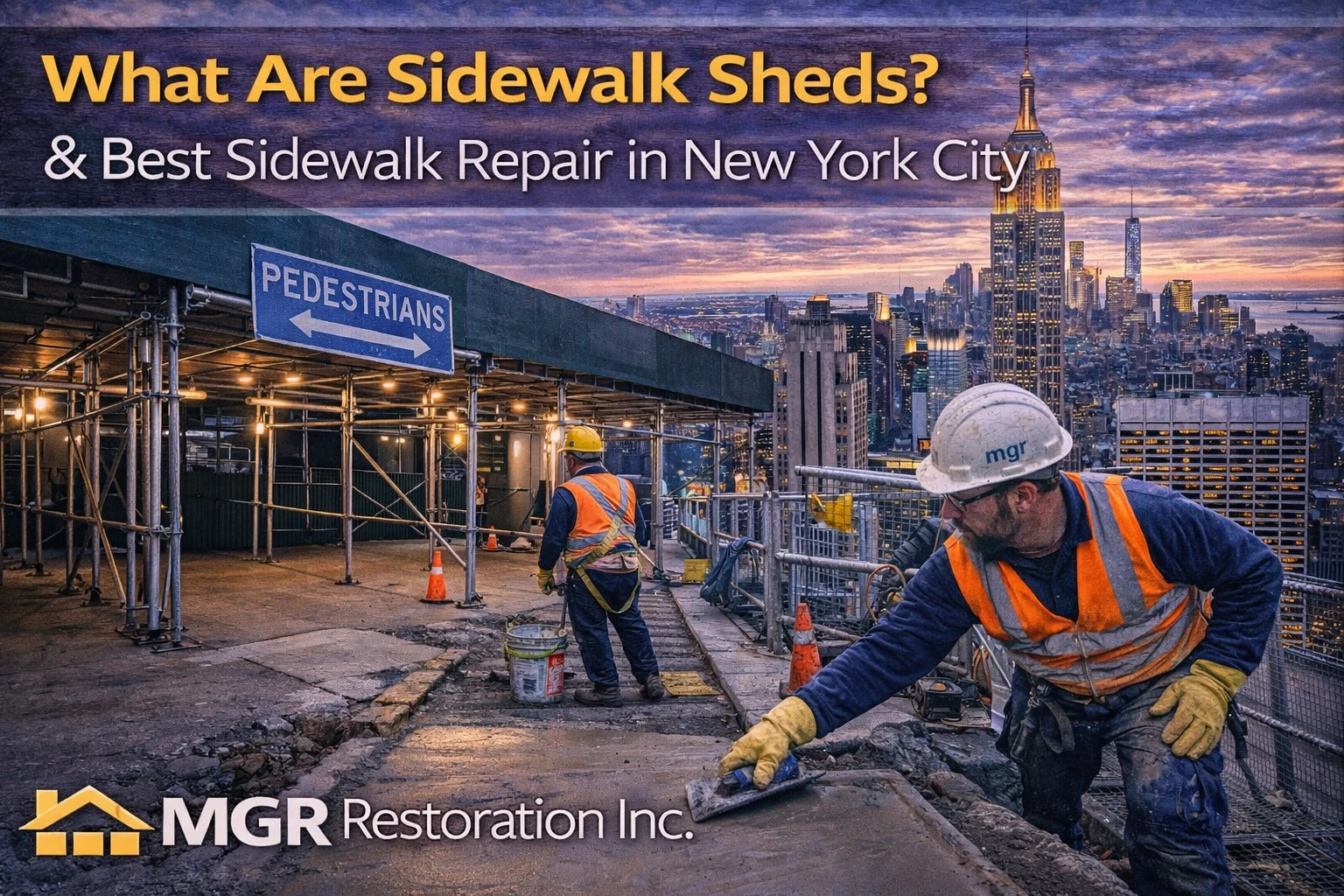
If you walk through New York City, you see them on almost every block. Dark tunnels made of steel beams and wood covering the sidewalk. These structures are called sidewalk sheds.
Many people call them scaffolding, but that is not technically correct. A sidewalk shed is built to keep pedestrians safe from falling debris. Scaffolding is built for workers to stand on while making repairs.
At MGR Restoration Inc, we have spent over 20 years helping property owners navigate NYC’s strict building codes. This guide explains exactly what sidewalk sheds are, why the city requires them, and how our team provides the best sidewalk repair in New York City to help you avoid heavy fines.
What Is a Sidewalk Shed?
A sidewalk shed is a temporary heavy-duty structure built over a public walkway. Its main job is to protect people on the ground from objects that might fall from a building above.
In New York City, the Department of Buildings (DOB) has very strict rules regarding public safety. You must install a sidewalk shed if you are:
- Constructing a new building taller than 40 feet.
- Demolishing a building taller than 25 feet.
- Repairing the façade (exterior walls) of a building over six stories.
The shed features a reinforced deck (roof) designed to hold massive weight. If a loose brick, tool, or piece of concrete falls, it hits the shed deck instead of a pedestrian.
Sidewalk Shed vs. Scaffolding: What is the Difference?
Property owners often confuse these two terms. Here is the simple difference:
- Sidewalk Shed: Protects people on the ground. It acts as a shield.
- Scaffolding: Supports workers in the air. It is a temporary platform for construction crews.
Often, you will see scaffolding erected on top of a sidewalk shed during major façade restoration projects.
Why Are There So Many Sheds in NYC? (Local Law 11)
New York City currently has thousands of active sidewalk sheds. Some seem to stay up for years. Why does this happen?
The primary reason is Local Law 11, now officially called the Façade Inspection and Safety Program (FISP).
- Buildings taller than six stories must have their exterior walls inspected every five years by a Qualified Exterior Wall Inspector (QEWI).
- If the inspector finds a hazard—like a loose brick, cracked terracotta, or rusting steel—the building is classified as “Unsafe.”
- By law, the building owner must install a sidewalk shed immediately to protect the public.
- The shed cannot be removed until the repairs are completely finished, inspected, and approved by the DOB.
As Local Law 11 experts, MGR Restoration Inc specializes in making these critical façade repairs quickly so you can take the shed down and stop paying rental fees.
Sidewalk Repair in New York City: Who is Responsible?
If the concrete sidewalk in front of a building is cracked or broken, who has to fix it? The City of New York or the property owner?
The Property Owner is Responsible. According to NYC Administrative Code § 7-210, the owner of the building adjacent to the sidewalk must maintain it. If a pedestrian trips and falls on a broken flag (concrete square) in front of your building, you are legally liable and could face a major lawsuit.
The Only Exceptions
The City is only responsible for sidewalk maintenance if:
- The property is a 1, 2, or 3-family home used only for residential purposes, AND
- The owner lives there (owner-occupied).
For all commercial buildings, mixed-use properties, and larger apartment complexes, the owner must pay for the repairs.
Why MGR Restoration Inc is the Best Choice for Sidewalk Repair
When you need sidewalk repair or replacement, you cannot hire a standard handyman. You need a licensed contractor who understands NYC regulations. Here is how MGR Restoration Inc solves your sidewalk problems:
1. Complete Violation Removal
We do not just pour concrete; we handle the bureaucracy. We secure the necessary DOT permits, perform the exact repairs required, and file the Dismissal Request to officially remove the violation from your property record.
2. Underground Vault Repair Specialists
Many older buildings in NYC have hollow vaults located directly beneath the sidewalk. These were historically used for coal storage but now house utilities. If water leaks through the sidewalk into the vault, it causes severe structural damage. We specialize in Vault Repair & Restoration, providing structural reinforcement and advanced waterproofing to protect your building’s foundation.
3. High-Performance Concrete
We strictly use high-performance 4,000 PSI concrete for all sidewalk replacements. This commercial-grade strength is required to withstand harsh NYC winters, heavy foot traffic, and the constant stress of the urban environment.
4. ADA-Compliant Installations
All our sidewalk repairs and pedestrian ramps are built to exact Americans with Disabilities Act (ADA) standards, ensuring accessibility and safety for everyone.
Dealing with DOT Sidewalk Violations
The Department of Transportation (DOT) regularly sends inspectors to check NYC sidewalks. If they find damage, they will issue a Notice of Violation. They look for:
- Trip Hazards: Vertical cracks or uneven concrete larger than half an inch.
- Spalling Concrete: Crumbling holes or loose stones on the surface.
- Tree Root Damage: Roots pushing the concrete blocks upward.
- Improper Slope: The sidewalk pools water instead of draining it to the street.
If you receive a violation, you typically have 75 days to fix the issue. If you ignore it, the City will hire its own contractor to do the work and send you a highly inflated bill.
Frequently Asked Questions (FAQ)
Do you have an active DOT violation or need an estimate for façade repairs? Call MGR Restoration Inc today at 718-240-0000 or visit our office at 48-11 69th Street, Woodside NY 11377. Let us handle the city codes so you can focus on your business.