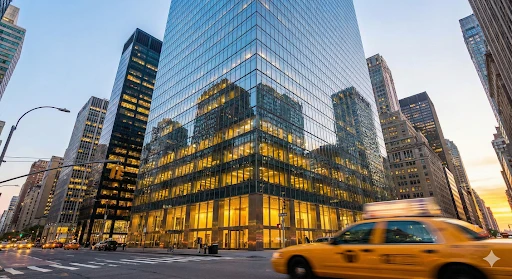
New York City’s Skyline is embellished by shimmering glass and sleek metal facades. From the corporate towers of Midtown to the luxury condos of Tribeca, curtain walls—non‑load‑bearing exterior skins made of glass, metal or composite materials—have become the architectural signature of the metropolis. These systems create transparent envelopes that let daylight flood the interior, provide commanding views of the city and give buildings a lightness that seems to defy gravity.
Yet behind their immaculate surfaces lie complex assemblies of gaskets, sealants, anchors and drainage channels that must keep out water, resist wind, accommodate structural movement and meet stringent codes. As New York’s stock of mid‑century towers ages and new high‑rises push the limits of form and performance, owners and facility managers face the challenge of maintaining these sophisticated skins.
This article offers a comprehensive guide to curtain wall maintenance in New York. It begins with a brief history of how curtain walls came to dominate the city’s architecture, then outlines the environmental and regulatory pressures unique to the five boroughs. It examines common modes of deterioration—sealant decay, water infiltration, structural movement and thermal bridging—and presents modern solutions ranging from high‑performance glazing to sensor‑enabled façades. A summary table highlights typical problems and their remedies. Throughout, the focus is on practical strategies for preserving the beauty, safety, and value of New York’s skyscrapers.
A Brief History of the Curtain Wall in New York
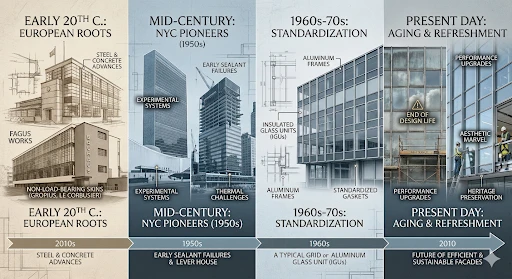
Curtain walls emerged in the early twentieth century when advances in steel and reinforced concrete freed façades from their traditional load‑bearing role. European modernists such as Walter Gropius and Le Corbusier envisioned buildings wrapped in continuous glass, with the structure expressed independently. Early examples like the Fagus Works in Alfeld and the Bauhaus Building in Dessau demonstrated that a lightweight, non‑structural skin could create flexible, open interiors. By the mid‑twentieth century, American architects embraced the aesthetic; New York landmarks such as the United Nations Secretariat (1952) and Lever House (1952) introduced the fully glazed curtain wall to Manhattan.
These pioneering systems were experimental. Early sealants lacked elasticity and quickly failed, while aluminum framing had yet to be thermally broken. Architects learned through trial and error that removing the structural function of the wall created new challenges: moisture control, thermal insulation and accommodation of differential movement became critical. By the 1960s, aluminum frames, insulated glass units (IGUs) and standardized gaskets had become common. Many of these mid‑century façades, now 50–70 years old, are approaching the end of their design life. Their refreshment opens new avenues of efficient energy performance and aesthetic marvel with a flair of heritage of modern architecture.
New York’s Unique Challenges
Climate and Environmental Stress
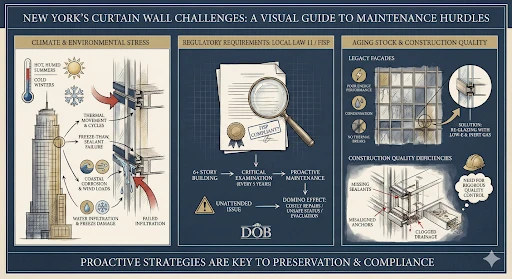
New York’s climate tests the extreme ends of the spectrum, experiencing a continental climate that summons the harshness of hot, humid summers and cold winters. This climate inflicts thermal expansion and contraction cycles on framing members and glazing, straining joints and gaskets. These extreme climactic conditions trigger a freeze and thaw cycles, drying out elastomeric seals, cracking brittle sealants, and causing the damage of gaskets, coatings, and adhesive tapes.
These detrimental effects pick further fury on account of the city’s coastal location, which not only introduces salt and pollutants to corrode metal components and stain surfaces of curtain walls, but also subjects them to destructive wind loads.
Water intrusion is the most rudimentary source of distress for curtain walls. This intrusion causes failure of elastomeric gasket, allowing failed sealant joints to allow water through them. This water can freeze during extreme winters, causing widening of the crack that would later serve as an entrance for liquids outpouring from the exterior.
Regulatory Requirements: Local Law 11 / FISP
Façade regulations in NY need to meet the most stringent rules imposed by building codes. Façade Inspection Safety Program (FISP) demands every more than six story building of New York to undergo a critical examination every five years. These regulations, along with numerous others imposed by the Department of Building, beg for robust and proactive maintenance strategies. Furthermore, any unattended issue, i.e. sealant failure, can trigger domino effect, causing huger repairing cost. In some cases, this could lead to the building being deemed unsafe, resulting in evacuation orders.
Aging Stock and Construction Quality
New York’s building stock spans a range of curtain wall technologies. Early systems used steel frames and basic single glazing. Later ones employed aluminum mullions and double glazing but lacked thermal breaks. These legacy façades often exhibit poor energy performance, condensation and corrosion. Upgrading them can be challenging because the original frames may not accommodate thicker, high‑performance glass or modern anchorage details. In many cases, re‑glazing with low‑emissivity coatings and inert gas fills offers the most feasible improvement without complete replacement.
Construction quality has varied over the decades. Common deficiencies include missing or improperly applied sealants, poorly designed flashings, lack of movement joints, misaligned anchors, and clogged drainage paths. Sometimes joint deterioration stems from misaligned tolerances, which is a subsequent flaw born of poor coordination between structural engineers and façade consultants during the design phase. Thus, all these issues present a compelling argument in favor of rigorous quality control and improved maintenance strategies for curtain walls.
Modes of Degradation
Gasket and Sealant Degradation:
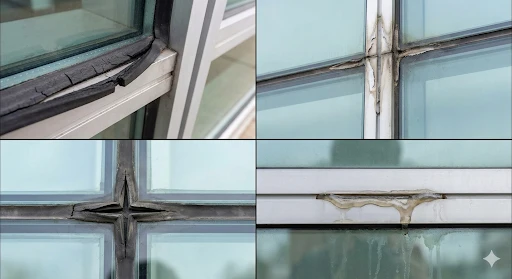
Elastomeric gasket provides an initial barrier to prevent water and air intrusion. However, protracted exposure to UV light, ozone, and temperature variation causes it to shrink, harden, and eventually crack. The removal of the gasket leaves the glass bare and vulnerable to moisture infiltration. Furthermore, sealants, like silicone and polyurethane, come with a limited service life, eventually becoming susceptible to shrinkage, discoloration, brittleness, and cracking.
Water and Air Invasion:
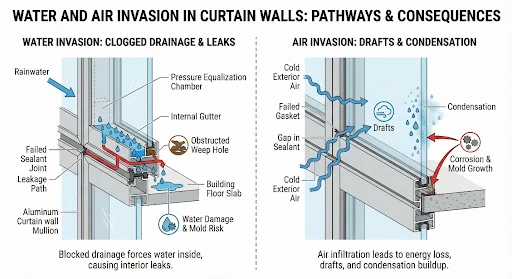
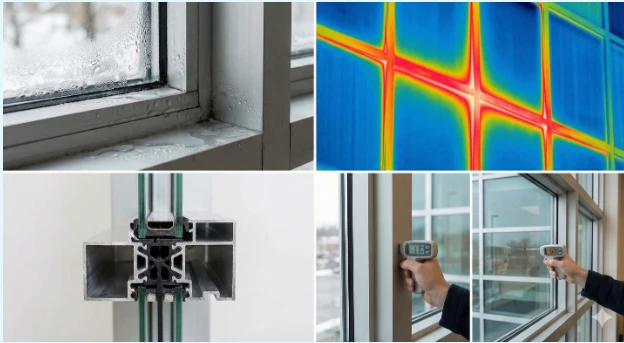
Water in curtain walls is controlled through facilities like pressure equalization chamber, internal gutters, end dams, and weep holes. When these facilities are obstructed, water, finding no drainage path, accrues inside the mullions and leaks into the building. Similarly, the failure sealants permits the infiltration of air, allowing drafts and condensation. Condensation, in turns, provides a conducive environment for mold and corrosion to set in, birthing a necessity for cleaning of weep holes and verification of drainage spots.
Structural Movement and Differential Drift:
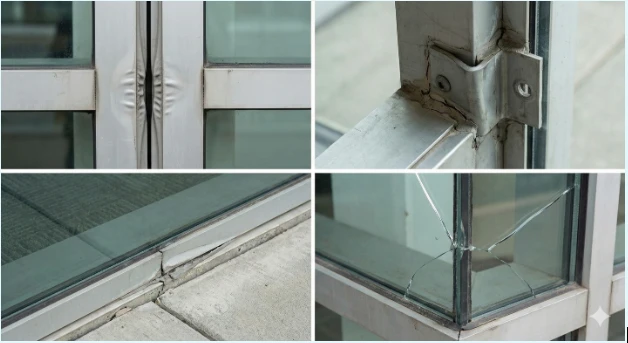
High‑rise buildings sway under wind loads and expand or contract with temperature changes. Floor slabs and columns shorten under gravity loads, while cladding may not move identically. Curtain walls must accommodate this differential movement through slotted anchors, flexible gaskets and expansion joints. If movement joints are missing or undersized, glass can break or anchors can fail. Seismic events, though less frequent in New York than on the West Coast, also introduce lateral drift that must be considered in design and maintenance.
Thermal Bridging and Energy Loss:
Older curtain walls often lack thermal breaks in the aluminum frame. Metal is an excellent conductor of heat, so cold exterior surfaces draw heat from the interior in winter (and vice versa in summer), increasing energy consumption and causing condensation. Upgrading to thermally broken framing or installing interior shading devices can improve performance. Modern IGUs with low‑emissivity coatings and argon gas fills dramatically reduce heat transfer.
Material Deterioration
Sunlight, pollution and salt attack the protective coatings on aluminum and steel. Painted or anodized finishes fade and chalk, while untreated steel rusts. Glass surfaces accumulate dirt and may suffer from etching or staining. Spandrel panels and insulating back‑pans can deteriorate, exposing insulation. Regular cleaning and application of protective coatings prolong the life of these components.
Modern Solutions and Innovations
High‑Performance Materials and Systems
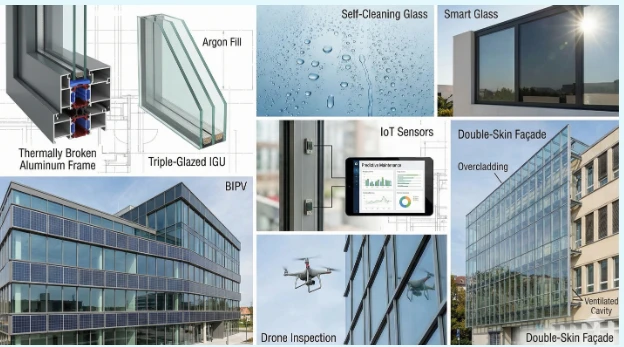
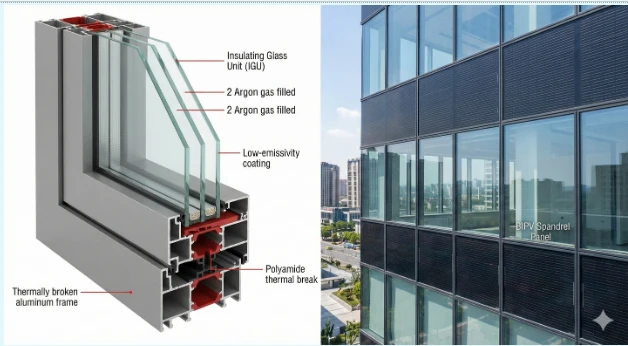
Recently, the use of advanced materials has ushered significant advances in curtain technology. It is recommended to use thermally broken aluminum frames in curtain walls. They use plastic insulators to separate external and internal metal components and reduce heat transfer. Similarly, unprecedented thermal transmittance values can be obtained by using high-performance IGUs. They feature low-emissivity coatings, inert gas fills, and triple glazing.
Use of photovoltaics (BIPV) in façades offers the beneficial duality of electricity generation and interior shading. BIPV is used in curtain walls, replacing spandrel panels with solar cells, to prolong their life and reduce maintenance.
Self‑Cleaning and Smart Glass
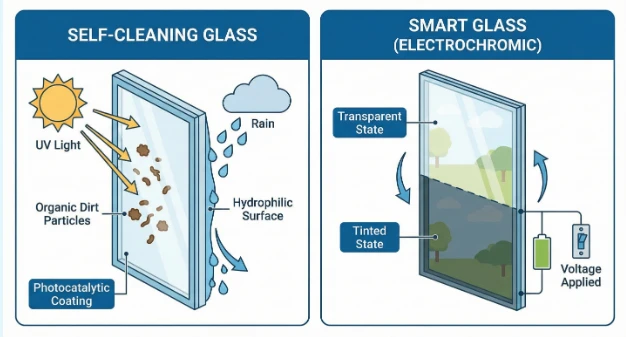
A few years ago, the concept of self-cleaning glass appeared like a concept ripped out of sci-fi stories. However, with nanotechnology, it is actually possible to design curtain walls with self-cleaning glass. The glass is a combination of photocatalytic coatings and a hydrophilic surface, which help it break down organic dirt and shed rainwater for cleaning, respectively. Subsequently, it reduces the frequency of manual cleaning and enhances safety for window washers.
Furthermore, it helps with energy optimization. Electrochromic glass exhibits a change in tint in response to sunlight, thus reducing glare and controlling heat intrusion. Installing thermochromic glass in curtain walls provides a passive solar control system without electrical output as heat darkens it. These techniques not only increase occupant comfort but also mitigate the wear of curtain walls.
Sensors and Predictive Maintenance
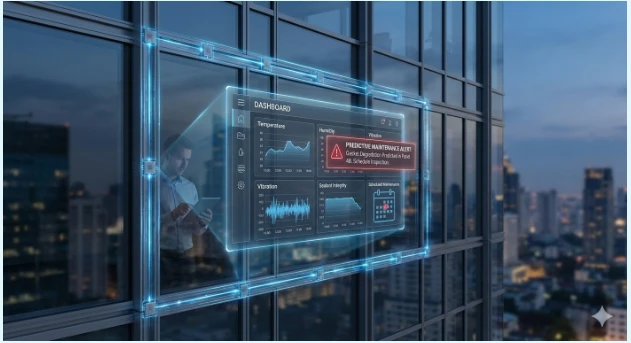
The advent of the Internet of Things (IoT) has impacted every aspect of architecture and construction, revolutionizing it into a digital space. Curtain walls can be monitored with helps of various sensors embedded in mullions and anchors, controlling temperature, humidity, wind pressure, and movement. Furthermore, if there is an intrusion of water or moisture, these sensors would trigger a warning, asking the occupant to take corrective measures before water can leak into occupied spaces.
Machine learning and data-driven algorithms can predict the failure of seals and gaskets’ diminished elasticity before their rupture. Building owners can use these predictions to schedule maintenance and prevent emergencies. Sensors can also be personalized based on FISP regulations and documentation, ensuring compliance.
Drone and Robot Inspection
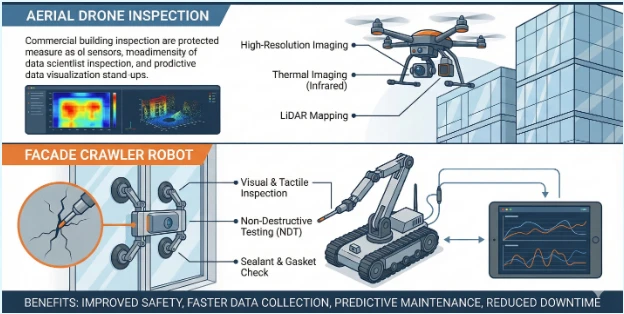
The manual inspection and cleaning duties of curtain walls require swing stages or ropes, which impose a hazard to workers. Modern drones, along with different budding technologies, including infrared sensors, and LiDAR, can work efficiently to examine and maintain curtain walls. These tools can help to document visual proof of faulty sealants, fracture glass panels, weakened gaskets, and thermal loss. These visual proof helps to program robots capable of testing and examining curtain walls, diminishing dependence on manual labor.
Overcladding and Double‑Skin Façades
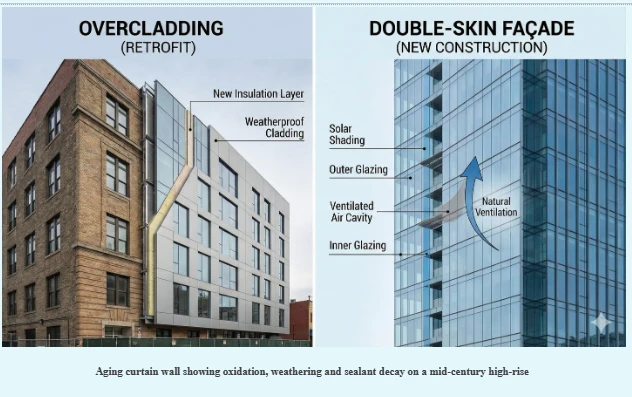
For buildings where the existing curtain wall cannot economically meet modern performance requirements, overcladding offers a solution. In this approach, a brand new curtain wall is installed over the original one, resulting in an insulated cavity that tweaks thermal efficiency and air tightness for occupants. Double‑skin façades consist of two layers of glass separated by a ventilated cavity; they reduce heating and cooling loads, buffer noise and allow natural ventilation through the stack effect. Such systems must be carefully designed to avoid overheating and to comply with fire codes, but they demonstrate how innovations can revitalize aging towers.
Maintenance Strategies
- Routine Inspection and Documentation:
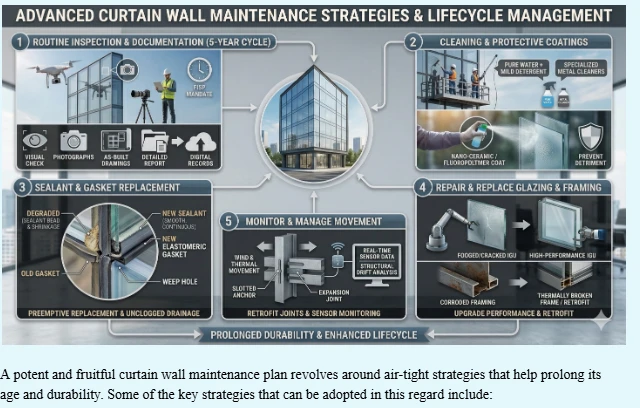
It is recommended for building owners to perform a visual inspection, either from the ground or the rooftop, of curtain walls at least every five years, as mandated by the FISP regulation. The findings and results of these inspections must be documented in detail along with photographs, relevant as-built drawings, and notes. Owners should employ all means available (for example: drones) for areas that are hard to access through ropes and cables.
- Cleaning and Protective Coatings:
Maintain a cleaning schedule that is conducive to the building’s environment. During the washing process, it is advised to utilize pure water along with mild detergents for glass panels and specialized cleaners for metal panels. It is recommended to use nano-ceramic or fluoropolymer coats to prevent aluminum and stainless steel from detrimental elements.
- Sealant and Gasket Replacement.
Gasket and sealant degradation is usually preceded by shrinkage, cracking, and discoloration. This is a clear indicator that the leak is imminent and, as a preemptive measure, gaskets should be replaced. Ensure that the new sealant does not clog weep holes and that gasket corners are well spliced.
- Repair or Replace Glazing and Framing:
Replace fogged or cracked IGUs with high‑performance units. If framing lacks thermal breaks or is severely corroded, consider a more extensive retrofit or overcladding. When re‑glazing, coordinate tolerances and movement joints to accommodate structural drift.
- Monitor and Manage Movement:
It is recommended to monitor existing joints and anchors, for their ability to resist wind and thermal movement contributes astronomically to the longevity of curtain walls. It is considered judicial to retrofit expansion joints or slotted anchors where necessary to allow these movements. Sensors can be considered a useful resort in this regard.
Conclusion
The glass and metal skins of New York’s skyscrapers symbolize modernity and progress. They flood interiors with light, provide breathtaking views and give the city its distinctive sparkle. Behind the gleam, however, lies a complex system of components that must withstand harsh weather, structural movement and the relentless effects of time. The combination of New York’s climate, regulatory framework and aging building stock makes curtain wall maintenance both challenging and vital.
By understanding the history of curtain wall construction, recognizing common modes of failure and adopting modern materials and technologies, building owners and managers can keep their façades safe, efficient and beautiful. Routine inspections, timely replacement of gaskets and sealants, and upgrades to high‑performance glazing or overcladding can extend the life of existing systems. Innovations such as self‑cleaning coatings, IoT sensors and drone inspections promise to make maintenance more predictive and less disruptive. With thoughtful planning and investment, the steel and glass skins of New York will continue to shine far into the 21st century.