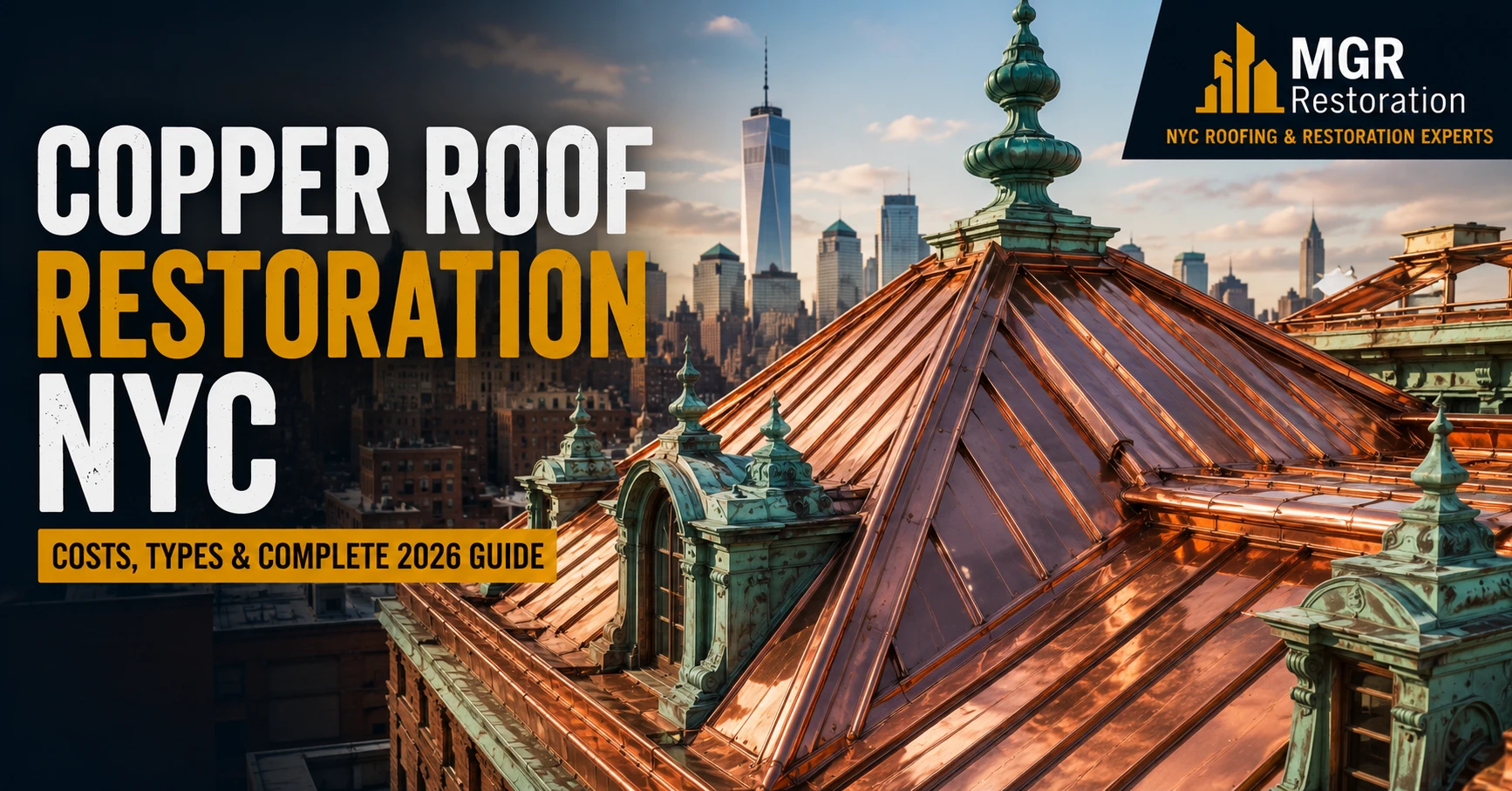
When you look at some of New York City’s most iconic buildings — churches, institutional buildings, prewar apartment towers, and landmark commercial structures — the rich green or blue-gray color at the roofline often belongs to one material: copper. Copper roof restoration in NYC is one of the most specialized services in the building restoration industry, and it is one that MGR Restoration has been delivering for over two decades across all five boroughs.
If your building has a copper roof — whether it is a standing seam copper roof on a historic brownstone, a flat seam copper system on a church, copper flashings at a parapet, or copper window panning on a landmark commercial building — this guide covers everything you need to know. From understanding how copper roofing works to recognizing when restoration is needed, what repairs cost in 2026, and how historic building requirements affect your options.
Why Copper Has Been NYC’s Premium Roofing Material for 200 Years
Copper did not become the preferred roofing material for New York City’s most significant buildings by accident. It earned that position through performance characteristics that no other material fully replicates — and those characteristics are as relevant today as they were when copper was first installed on NYC’s earliest churches and institutional buildings in the early 19th century.
Extraordinary Longevity
A properly installed copper roof lasts 70 to 100 years or more — longer than virtually any other roofing material available. While flat roof membranes require replacement every 15 to 30 years and even slate roofs eventually wear out, copper roofs installed in the 1800s are still in service on buildings across Manhattan and Brooklyn. This extraordinary longevity makes copper’s higher upfront cost highly competitive on a lifecycle basis when compared to materials that require replacement two or three times over the same period.
The Patina — Beauty and Protection in One
Copper’s color changes dramatically over time, and this transformation is not deterioration — it is protection. Fresh copper is bright, shiny, and reddish-orange. Within months of installation, it darkens to a rich brown. Over 5 to 30 years — depending on exposure, rainfall, and air chemistry — it develops the blue-green patina (verdigris) that defines the look of NYC’s historic copper roofs.
This patina is not just beautiful. It is a tight, adherent copper carbonate layer that actually protects the metal beneath from further corrosion. Once the patina has fully developed, the rate of copper loss from corrosion drops dramatically. A well-developed patina is a sign that a copper roof is performing exactly as intended.
Self-Healing Properties
Unlike most roofing materials, copper has a degree of self-healing capability. Small scratches and surface damage oxidize and develop patina, integrating visually with the surrounding material. This property makes copper roofs remarkably resistant to the kind of incidental damage that shortens the lifespan of other systems.
Compatibility With Historic Architecture
New York City’s most significant historic buildings — churches, libraries, courthouses, pre-war apartment towers, landmark commercial structures — were designed with copper roofing as an integral part of their architectural expression. The NYC Landmarks Preservation Commission (LPC) strongly favors copper restoration and replacement for landmark buildings that originally had copper roofing, making it the appropriate and often required choice for historic building restoration.
Types of Copper Roofing Found on NYC Buildings
Not all copper roofing is the same. The specific installation type affects the restoration approach, the repair methods available, and the cost of any remediation work.
Standing Seam Copper Roofing
Standing seam is the most common copper roofing system on NYC residential and smaller institutional buildings. Individual copper panels — typically 16 to 24 inches wide — run parallel to the roof slope and are joined at their edges by raised seams that are mechanically locked or soldered. The raised seams shed water effectively and accommodate the significant thermal expansion and contraction that copper undergoes with temperature changes.
Standing seam copper roofs are found on brownstones, townhouses, churches, and smaller institutional buildings throughout Brooklyn, Manhattan, and the other boroughs. They are particularly common in Historic Districts and on individually landmarked buildings.
Flat Seam Copper Roofing
Flat seam copper is used on low-slope or curved roof surfaces where standing seam would be impractical. Individual copper panels are soldered at their flat seams — creating a watertight joint without the raised profile of standing seam. This system requires more skill to install and restore than standing seam, because the integrity of the system depends entirely on the quality of the soldering at every seam.
Flat seam copper is common on complex roof geometries — dormers, curved sections, bay windows, and areas where the roof transitions around architectural features.
Batten Seam Copper Roofing
Batten seam roofing uses a wooden or metal batten covered by a copper cap to create the seam between adjacent panels. This system is typically used on curved surfaces — domes, barrel vaults, and cupolas — where it creates a distinctive ribbed appearance. Batten seam copper roofing is found on some of NYC’s most architecturally significant structures, including church domes and institutional building cupolas.
Copper Flashings
Even buildings with other primary roofing systems — modified bitumen, slate, EPDM — often use copper for flashings at critical water management locations. Copper flashings at parapet bases, around chimneys, at valleys, and at roof-to-wall transitions have exceptional longevity and are standard practice on high-quality roofing and landmark building projects.
MGR Restoration installs and restores copper flashings as part of our roofing and waterproofing services — including on buildings where copper flashings are required by LPC approval for landmark restoration work.
Copper Window Panning
Many of NYC’s pre-war commercial and institutional buildings feature copper window panning — copper cladding around the perimeter of window openings that protects the masonry at the window head, jambs, and sill from water infiltration. When window panning fails, water enters directly into the wall at the most vulnerable location. MGR Restoration’s work on 307 W 38th Street in Manhattan included steel shutters restoration and copper window panning — a scope that illustrates how copper elements appear throughout a building, not just at the roofline.
Copper Gutters and Downspouts
Custom copper gutters and downspouts are a premium drainage solution for historic and high-end buildings. They are exceptionally durable, develop an attractive patina, and are the appropriate choice — and often the required choice — for landmark buildings where LPC approval governs material selection.
Common Copper Roof Problems in NYC Buildings
Despite copper’s remarkable durability, problems do develop — particularly on older systems that have not had regular maintenance. Understanding what goes wrong helps building owners recognize when action is needed.
Seam Failure and Open Joints
On standing seam systems, the mechanical locks at seam joints can open over decades of thermal cycling — expanding and contracting with temperature changes. On flat seam systems, solder joints can crack or develop pinholes through age or improper original installation. Open seams allow water infiltration directly into the roofing assembly — the most common cause of copper roof leaks.
Corrosion at Dissimilar Metal Contacts
Copper is highly reactive when in contact with dissimilar metals — steel, aluminum, and galvanized materials in particular. Where copper touches or drains onto these metals, galvanic corrosion develops rapidly, damaging the adjacent material. This is why copper fasteners, copper straps, and copper-compatible flashing materials must be used throughout a copper roofing system.
On older NYC buildings, previous improper repairs often introduced incompatible metals — leading to localized corrosion damage that requires careful remediation.
Mechanical Damage
Impact damage from tools, HVAC equipment installation, or maintenance workers accessing the roof can puncture or crack copper — which, despite its durability, is relatively soft and can be damaged by concentrated impact. Punctures and cracks allow water infiltration at the point of damage.
Flashing Failures at Penetrations
Even the best copper roof field can be compromised by failing flashings at penetrations — pipes, vents, HVAC equipment, skylights. As the neoprene boots around pipe penetrations age and crack, water enters. As flashing solder joints at complex transitions fail, water finds its way in. Regular inspection and maintenance of all penetration flashings is the most important preventive maintenance for any copper roof.
Failed Solder Joints
On flat seam systems, solder joint failure is the primary failure mode. Age, thermal cycling, and the inevitable slight movement of the copper panels causes solder joints to crack over time. Once a solder joint opens, water enters the seam and begins working its way under the panel. Flat seam copper restoration requires re-soldering every compromised joint — skilled work that requires an experienced copper roofer.
Copper Theft
Sadly, copper theft from NYC buildings is a real concern — copper’s value as a metal makes it a target on unoccupied buildings or buildings with accessible roof areas. Where copper has been stolen, emergency temporary repairs followed by proper copper replacement are required.
Copper Roof Restoration vs Copper Roof Replacement — Which Do You Need?
This is the central question for any building owner dealing with a failing copper roof. The answer matters enormously — copper roof restoration can cost a fraction of full replacement, but if the system is too far gone, restoration money is wasted.
When Copper Roof Restoration Is Appropriate
Restoration is appropriate when:
- The copper field panels are in generally sound condition — no significant punctures, and most seams are intact
- Failures are localized — specific seam sections, specific penetration flashings, or isolated areas of damage
- The copper has not been thinned by corrosion to the point of perforation across multiple areas
- The underlying substrate (roof deck, insulation) is sound
In these cases, restoration — re-soldering open joints, replacing failed flashings, repairing damaged panels, treating localized corrosion — can extend the roof’s life by 20 to 40 years at a fraction of replacement cost.
When Copper Roof Replacement Is Required
Replacement is required when:
- The copper has thinned to the point of widespread perforation — pinhole leaks across multiple areas
- Previous improper repairs using incompatible materials have caused widespread dissimilar metal corrosion
- The underlying substrate has been damaged by long-term water infiltration and requires replacement
- Theft or catastrophic damage has removed large sections of the copper field
- The system is 80 to 100+ years old and has reached the natural end of its service life
Even at end of life, a copper roof is replaced with copper — not another material — on most NYC landmark buildings, because LPC requirements mandate material matching on historic structures.
Copper Roof Restoration and NYC Landmark Requirements
The overwhelming majority of buildings with copper roofs in New York City are either Individual Landmarks or are located within Historic Districts regulated by the NYC Landmarks Preservation Commission (LPC). This means that virtually all exterior work on these buildings — including copper roof restoration and replacement — requires LPC approval before work begins.
What LPC Requires for Copper Roof Work
Material Matching: LPC generally requires that copper roof repairs and replacements use copper of the appropriate gauge and alloy to match the original. Standard roofing copper is typically 16 to 20 oz per square foot (0.022 to 0.027 inches thickness). LPC may specify the exact gauge for replacement work.
Seam Profile: On standing seam roofs, the height and profile of the seam must match the original. On flat seam roofs, the panel size and seam pattern must be maintained.
Patina: LPC does not require that new copper match the aged patina of surrounding copper immediately — natural weathering is accepted. However, where new copper is being integrated with aged sections on a landmark building, LPC may require chemical pre-patination to reduce the visual contrast.
Fasteners and Accessories: All fasteners, cleats, and accessories must be copper or copper-compatible — not steel, aluminum, or galvanized materials.
Documentation: LPC requires condition documentation, scope of work descriptions, and material specifications as part of the application package.
MGR Restoration prepares complete LPC application packages for copper roof restoration projects — drawing on our experience with landmark restoration work across NYC Historic Districts including Brooklyn Heights, Park Slope, SoHo, Tribeca, and Manhattan’s numerous designated districts.
Our work on the Polhemus Building at 350 Henry Street in Cobble Hill — an 1896 landmark — included new SBS roof installation and copper flashings as part of a comprehensive facade and building restoration, demonstrating our ability to integrate copper work with broader landmark restoration scopes.
Copper Roof Restoration Costs in NYC — 2026 Price Guide
Copper roof restoration and replacement costs vary significantly based on roof size, system complexity, extent of damage, access requirements, and whether LPC filing is required. Here is a comprehensive 2026 cost guide:
Copper Restoration Costs (Repair)
| Scope | Estimated Cost Range |
|---|---|
| Seam re-soldering — localized (per linear ft) | $25 – $75 per linear ft |
| Penetration flashing replacement (per penetration) | $400 – $1,500 |
| Copper panel section replacement (per sq ft) | $35 – $90 per sq ft |
| Full flat seam restoration — re-soldering all joints | $15 – $30 per sq ft |
| Copper gutter repair (per linear ft) | $30 – $80 per linear ft |
| Copper flashing replacement at parapet (per linear ft) | $40 – $100 per linear ft |
Copper Replacement Costs (New Installation)
| System Type | Cost per Square Foot (installed) |
|---|---|
| Standing seam copper — new installation | $45 – $90 per sq ft |
| Flat seam copper — new installation | $55 – $110 per sq ft |
| Batten seam copper (domes, curved) | $70 – $150+ per sq ft |
| Copper gutters — custom fabrication & installation | $60 – $150 per linear ft |
| Copper window panning (per window) | $500 – $2,500 per window |
Total Project Cost Examples
| Project | Estimated Total Cost |
|---|---|
| Brownstone standing seam restoration | $8,000 – $25,000 |
| Brownstone full copper replacement | $25,000 – $60,000 |
| Church dome copper restoration | $30,000 – $100,000+ |
| Mid-rise building copper parapet flashings | $15,000 – $50,000 |
| Full copper roof replacement — institutional building | $100,000 – $500,000+ |
| LPC documentation and filing | $3,000 – $10,000+ |
Why Copper Costs More — And Why It’s Worth It
The upfront cost of copper roofing is significantly higher than alternative systems — but when evaluated on a 100-year lifecycle basis, copper is often the most cost-effective choice for buildings where it is appropriate. A $50,000 copper roof replacement that lasts 80 years has a lower annualized cost than a $25,000 modified bitumen replacement that needs to be done again in 20 years. For landmark buildings where replacement requires LPC approval and specialist contractors regardless of material, this lifecycle advantage is even more pronounced.
The Copper Roof Restoration Process — Step by Step
Step 1 — Condition Assessment
We conduct a thorough close-up inspection of the entire copper roof — examining every seam, every flashing, every penetration, and every panel for evidence of failure, thinning, or damage. On flat seam systems, this often involves flood testing to identify exact leak locations.
Step 2 — Moisture and Substrate Assessment
We assess the condition of the roof deck and insulation below the copper to determine whether water infiltration has damaged the substrate. Damaged substrate must be repaired or replaced during restoration — installing new copper over damaged decking creates problems that will surface within a few years.
Step 3 — Written Scope and Estimate
We provide a detailed written scope identifying every condition to be addressed and the specific repair or replacement approach for each — with transparent, itemized pricing. No lump sums, no surprises.
Step 4 — LPC Filing (for Landmark Buildings)
For buildings requiring LPC approval, we prepare and submit the complete application package — condition documentation, scope descriptions, material specifications, and sample submissions. We track the approval process and coordinate with LPC reviewers as needed.
Step 5 — Access Setup
For copper work above the first floor, we install appropriate access — scaffolding, suspended scaffold systems, or aerial lifts depending on building height and roof configuration.
Step 6 — Restoration or Replacement Execution
Our skilled copper roofers execute the approved scope — re-soldering seams, replacing damaged panels, installing new flashings, and integrating new work with existing copper in a manner that is both watertight and visually appropriate. All work is executed with copper-compatible materials throughout.
Step 7 — Final Inspection and Waterproofing Verification
We conduct a thorough inspection including water testing before closing up access. For LPC projects, we document completed work with photographs for the close-out filing.
Maintaining Your NYC Copper Roof — Making It Last a Century
A copper roof that receives proper maintenance will last 80 to 100 years. Here is what that maintenance program looks like:
Every Year:
- Clear all copper gutters and downspouts of debris — particularly leaf buildup in fall
- Inspect all penetration flashings for separation, cracking, or failed boots
- Look for any new openings at seams — standing seam locks opening, flat seam solder failures
- Check for any new mechanical damage — punctures, dents, or distortions from rooftop activity
- Ensure HVAC equipment is properly supported on copper-compatible pads, not in direct contact with aluminum or steel
Every 5 Years:
- Professional copper roof inspection by a qualified contractor
- Re-soldering of any open or suspect seams on flat seam systems
- Replacement of aged neoprene boots at pipe penetrations
- Inspection and resealing of all perimeter flashings
Every 20–30 Years:
- Major restoration — comprehensive re-soldering on flat seam systems, systematic replacement of any panels that have thinned below acceptable limits
- Full copper gutter and downspout inspection and partial replacement where needed
The relatively modest investment in regular maintenance extends a copper roof’s life dramatically and prevents the small problems that grow into major restoration projects.
Copper Roof Restoration Across All Five NYC Boroughs
MGR Restoration provides copper roof restoration and installation services throughout New York City:
Manhattan — Institutional buildings in Midtown, pre-war apartment towers on the Upper West and Upper East Side, churches throughout the borough, landmark commercial buildings in SoHo and Tribeca, and residential buildings throughout all Manhattan neighborhoods. Manhattan’s concentration of landmark buildings makes copper roofing expertise particularly important here.
Brooklyn — Brownstones and townhouses in Park Slope, Brooklyn Heights, Carroll Gardens, and Cobble Hill; churches throughout the borough; landmark buildings in numerous Historic Districts. Our restoration work on the landmarked Polhemus Building at 350 Henry Street in Cobble Hill demonstrates our Brooklyn landmark expertise.
Queens — Institutional buildings, churches, and residential properties throughout Astoria, Forest Hills, and communities across the borough. MGR Restoration’s office is based in Woodside, Queens — giving us particularly strong local knowledge and rapid response capability in the borough.
The Bronx — Churches, institutional buildings, and residential properties throughout Riverdale, Fordham, and communities across the borough. The Bronx has a significant stock of pre-war buildings where copper roofing is appropriate and, for landmarks, required.
Staten Island — Residential and institutional copper roof restoration throughout the borough, including properties in St. George and Stapleton where historic building stock is concentrated.
Frequently Asked Questions
Get a Free Copper Roof Restoration Estimate — All NYC Boroughs
Whether your NYC building has a standing seam copper roof in need of seam restoration, a flat seam system with failing solder joints, copper flashings that have failed at a parapet, or a complete copper roofing system at end of life, MGR Restoration has the specialist expertise, skilled craftsmen, and LPC experience to restore or replace it correctly.
📞 Call now: 718-240-0000 🌐 Schedule a Free Assessment 🔧 View All Roofing Services 📁 View Our Projects
📍 Serving Manhattan · Brooklyn · Queens · The Bronx · Staten Island 📍 48-11 69th Street, Woodside NY 11377 | contact@nyrestoration.com