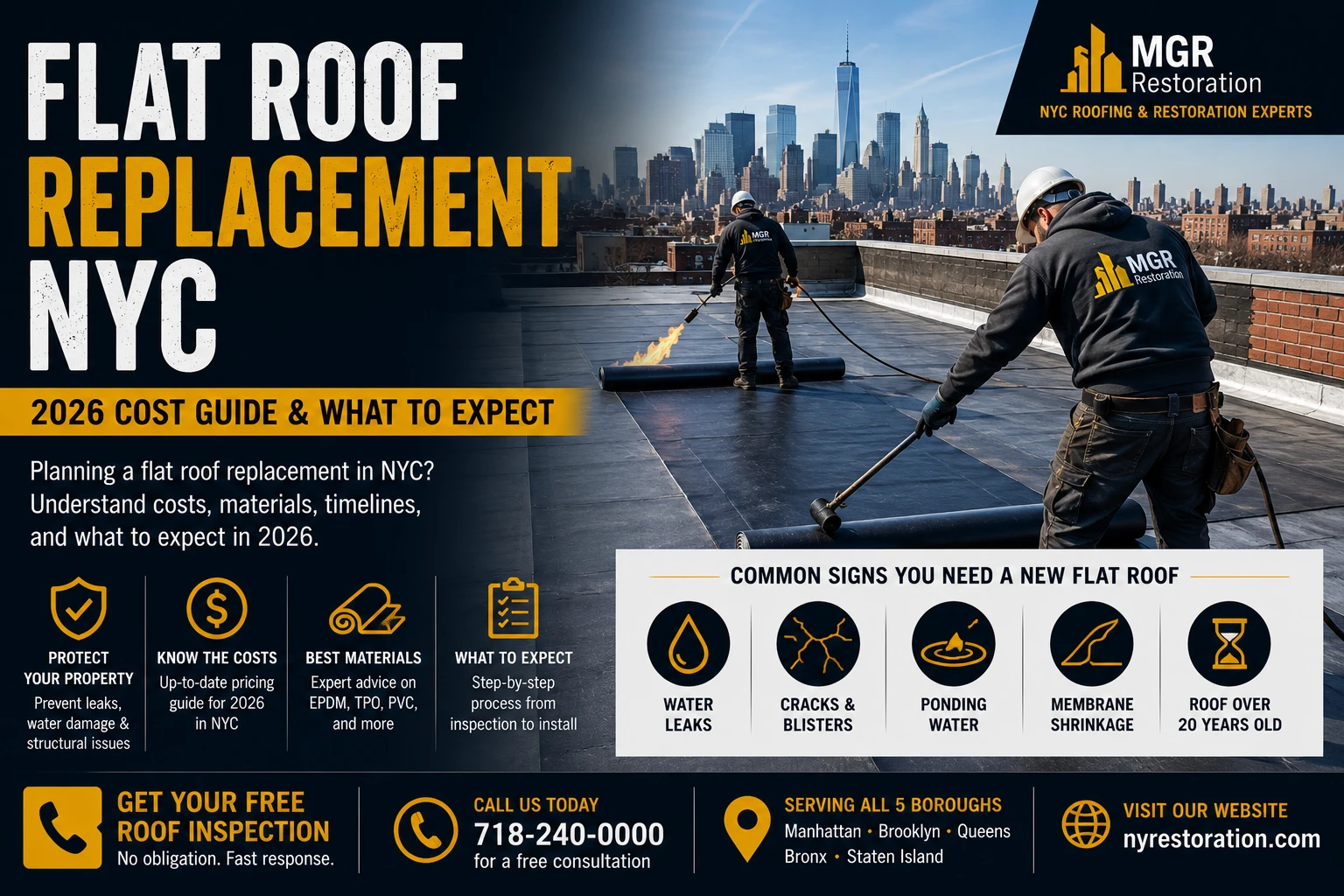
If you own or manage a building in New York City with a flat roof, there is a conversation you will eventually have to have — repair or replace? And if replace, how much will it cost, how long will it take, and what system should you use?
Flat roof replacement in NYC is one of the most significant building maintenance expenditures a property owner will face. Get it right and your building stays dry and protected for 20 to 30 years. Get it wrong — wrong system, wrong contractor, wrong timing — and you are dealing with leaks, interior damage, and another replacement far sooner than you should be.
MGR Restoration provides flat roof replacement and recovery services for residential and commercial buildings across all five boroughs of New York City. This guide covers everything you need to know to make an informed decision in 2026.
Why Flat Roofs Are So Common in NYC
Walk through any New York City neighborhood and look up. The overwhelming majority of buildings — from four-story brownstone walk-ups in Brooklyn to mid-rise apartment buildings in the Bronx to commercial loft buildings in Manhattan — have flat or low-slope roofs. This is not an accident.
Flat roofs dominate NYC’s building stock for practical reasons rooted in the city’s density and architectural history. They maximize usable interior floor space on every level, allow buildings to be built wall-to-wall without the setbacks that pitched roofs require, and were the standard construction approach for the multi-family and commercial buildings that defined NYC’s development from the late 19th century onward.
But flat roofs come with a fundamental challenge that pitched roofs do not share: water does not run off them quickly. Instead, it sits, ponds, and finds its way into any weakness in the roofing membrane. In NYC’s climate — with over 46 inches of annual rainfall, heavy snowfall, and brutal freeze-thaw cycling — that challenge is amplified. A flat roofing system that is not properly installed and maintained will fail, and when it fails, the consequences cascade downward through the building.
Signs Your NYC Flat Roof Needs Replacement — Not Just Repair
The most important — and most commonly misunderstood — question in flat roofing is whether your roof needs repair or full replacement. Patching a roof that should be replaced is money wasted. Replacing a roof that could have been repaired is money unnecessarily spent.
Here are the warning signs that point toward full flat roof replacement:
Age of the Existing System
Every flat roofing system has a finite design life. Modified bitumen systems typically last 15 to 20 years. EPDM rubber roofs last 20 to 30 years when properly maintained. TPO systems are rated for 15 to 30 years. Built-up roofing (BUR) lasts 20 to 30 years with maintenance.
If your roof is approaching or has exceeded its design life, replacement is almost always more cost-effective than continued repair. Every repair on an aging membrane is a temporary fix on a system that is failing across its entire surface.
Multiple Active Leaks
A single isolated leak is typically a repair. Multiple leaks appearing in different locations — particularly if they are reappearing after previous repairs — indicate that the membrane has failed systemically. At that point, patching is chasing problems rather than solving them.
Widespread Membrane Blistering or Cracking
Blistering occurs when moisture or gas is trapped between the membrane and the substrate, creating raised bubbles across the roof surface. Widespread blistering indicates that the membrane has delaminated from its substrate — a condition that cannot be repaired patch by patch. Cracking across the membrane surface indicates UV degradation and age-related brittleness. Both conditions point toward replacement.
Significant Ponding Water After Rain
Flat roofs should drain within 48 hours of a rainfall event. If water is consistently ponding on your roof for days, it indicates that the roof’s drainage is compromised — either through blocked drains, inadequate slope, or structural deflection of the roof deck. Persistent ponding water accelerates membrane deterioration dramatically and may also indicate structural issues requiring engineering assessment.
Failed Flashings at Penetrations and Edges
The flashings around roof penetrations — pipes, vents, HVAC equipment, skylights — and at the roof perimeter and parapet walls are the most vulnerable elements of any flat roofing system. When these flashings fail, water pours directly into the building interior. If flashings are failing across multiple locations on an aging roof, it is a sign that the entire system is at end of life.
Interior Water Damage on Multiple Floors
If water infiltration through a failing roof has reached multiple floors of the building, the damage is both more extensive and more urgent than it might appear from above. Water that travels through a roofing assembly damages insulation, corrodes structural connections, causes mold growth in wall cavities, and damages finishes throughout the building. The longer replacement is deferred, the more extensive the interior remediation required alongside it.
Flat Roof Replacement vs Roof Recovery — Which Is Right for Your Building?
Before committing to full tear-off and replacement, there is an important option to consider: roof recovery — also called roof resurfacing or re-roofing.
What Is Roof Recovery?
Roof recovery involves installing a new roofing membrane directly over the existing one — without removing the old roof. This is faster, less disruptive, and significantly less expensive than full tear-off and replacement. Under certain conditions, it delivers equivalent performance to full replacement.
When Is Roof Recovery Appropriate?
Roof recovery is an option when:
- The existing roof substrate is structurally sound — no significant rot, delamination, or structural deflection
- There is currently only one existing roof membrane installed (most NYC building codes limit roof assemblies to two layers maximum)
- Moisture testing confirms the existing insulation is dry — wet insulation under a new membrane traps moisture and causes the new system to fail prematurely
- The roof deck is sound and level
When Is Full Replacement Required?
Full tear-off and replacement is required when:
- Two or more membrane layers already exist on the roof
- Moisture testing reveals wet insulation that must be removed and replaced
- The roof deck itself is damaged, rotted, or structurally compromised
- The existing system has failed so extensively that the substrate is damaged
MGR Restoration performs non-invasive infrared moisture scanning on all flat roof assessments — identifying wet insulation and compromised substrate before recommending replacement or recovery. This data-driven approach ensures that building owners get the right recommendation for their specific roof, not a one-size-fits-all approach.
Flat Roofing Systems Available in NYC — 2026 Guide
Choosing the right flat roofing system for your NYC building depends on the building type, roof configuration, existing conditions, budget, and performance priorities. Here is a comprehensive overview of the systems MGR Restoration installs:
Modified Bitumen (Mod Bit)
Modified bitumen is the most widely used flat roofing system in New York City, particularly for residential and mixed-use buildings. It consists of asphalt modified with polymers — either APP (atactic polypropylene) or SBS (styrene-butadiene-styrene) — that dramatically improve flexibility, crack resistance, and weather performance compared to traditional built-up roofing.
Installation methods: Torch-applied (heat welding), cold-applied adhesive, or self-adhered. Most NYC installations use torch-applied systems for superior bonding.
Lifespan: 15–25 years with proper maintenance.
Best for: Residential buildings, walk-up apartments, brownstone rooftops, smaller commercial buildings.
Advantages: Proven performance in NYC climate, cost-effective, excellent cold-weather flexibility, self-healing properties in SBS systems.
TPO (Thermoplastic Polyolefin)
TPO has become increasingly popular for commercial flat roofs in New York over the past decade. It is a single-ply membrane — a single layer of thermoplastic material heat-welded at seams to create a continuous watertight surface.
Lifespan: 20–30 years with proper installation and maintenance.
Best for: Commercial buildings, large roof areas, buildings where energy efficiency is a priority (white TPO is highly reflective).
Advantages: Excellent energy efficiency (cool roof — reduces cooling costs), lightweight, fast installation, strong seam welds, good chemical resistance.
EPDM (Ethylene Propylene Diene Monomer)
EPDM is a synthetic rubber membrane that has been used on flat roofs for over 50 years. It is extremely durable, flexible even in extreme cold, and has an excellent track record in NYC’s climate.
Lifespan: 20–30+ years.
Best for: Buildings where long-term durability is the primary priority, particularly low-traffic commercial roofs.
Advantages: Extremely long lifespan, excellent cold-weather performance, lightweight, environmentally friendly (recyclable), low maintenance.
Considerations: Black EPDM absorbs heat — can increase cooling loads in summer. White EPDM or TPO may be preferable for energy-conscious buildings.
Built-Up Roofing (BUR)
Built-up roofing — also called tar and gravel — is the traditional flat roofing system and is still installed and maintained on NYC buildings. It consists of multiple alternating layers of bitumen and reinforcing felts, topped with a flood coat of bitumen and aggregate (gravel or crushed stone).
Lifespan: 20–30 years with proper maintenance.
Best for: Older buildings where BUR was the original system and compatibility with existing flashings is important.
Advantages: Excellent redundancy (multiple layers), proven durability, fire-resistant aggregate top coat, good puncture resistance.
Liquid-Applied Roofing (Liquid Roof)
Liquid-applied systems are sprayed or rolled onto the existing roof surface, curing to form a seamless, monolithic waterproof membrane. They are particularly effective for roofs with complex configurations — many penetrations, unusual shapes, or areas where sheet membranes are difficult to detail.
Lifespan: 10–20 years depending on system and maintenance.
Best for: Complex roof configurations, recovery applications, roofs with numerous penetrations.
Advantages: Seamless (no seams to fail), excellent detail at penetrations, can be applied to existing roofs without tear-off in many cases.
NYC Building Code Requirements for Flat Roof Replacement
Flat roof replacement in New York City is subject to NYC Building Code requirements administered by the NYC Department of Buildings (DOB). Key requirements include:
Permits: A DOB permit is required for full flat roof replacement in NYC. MGR Restoration handles all permit applications and DOB filings as part of every replacement project.
Roof Layers: NYC Building Code limits roof assemblies to two layers of roofing. If your building already has two layers, a full tear-off is required before a new system can be installed.
Drainage: The NYC Building Code requires that roof drainage be designed to prevent ponding water. Replacement projects must address drainage adequacy — including drain sizing, overflow provisions, and slope.
Energy Code Compliance: New roof installations must comply with NYC Energy Conservation Code requirements — including minimum insulation R-values that have been significantly increased in recent code cycles. Adding insulation during flat roof replacement is often the most cost-effective time to upgrade building envelope energy performance.
Cool Roof Requirements: For most commercial and residential buildings in NYC, new roofing materials must meet reflectivity requirements under NYC’s Cool Roofs Law — making white TPO and EPDM increasingly standard.
For landmarked buildings or buildings in Historic Districts, additional LPC review may be required for visible roof elements. MGR Restoration navigates both DOB and LPC requirements on every applicable project.
Flat Roof Replacement Costs in NYC — 2026 Price Guide
Flat roof replacement costs in New York City vary significantly based on roof size, system type, existing conditions, access requirements, and permit fees. Here is a realistic 2026 cost guide:
Cost by Roofing System
| System | Cost per Square Foot (installed) | Notes |
|---|---|---|
| Modified Bitumen (2-ply torch) | $8 – $18 per sq ft | Most common in NYC residential |
| TPO (single-ply, mechanically attached) | $9 – $16 per sq ft | Popular for commercial |
| EPDM (fully adhered) | $8 – $15 per sq ft | Long lifespan, good value |
| Built-Up Roofing (BUR) | $10 – $20 per sq ft | Traditional, multi-layer |
| Liquid-Applied System | $6 – $14 per sq ft | Best for complex configurations |
Total Project Cost Examples
| Building Type | Roof Area | Estimated Total Cost |
|---|---|---|
| 4-story brownstone (full replacement) | 1,000–1,500 sq ft | $12,000 – $30,000 |
| 6-story residential walk-up | 2,500–4,000 sq ft | $25,000 – $70,000 |
| Mid-rise apartment building (10–15 floors) | 5,000–10,000 sq ft | $60,000 – $180,000 |
| Large commercial building | 15,000+ sq ft | $150,000 – $400,000+ |
What Affects the Final Cost
Tear-off and disposal: Full tear-off of existing roofing adds $2–$5 per square foot over recovery cost, plus dumpster and disposal fees in NYC — which are significant.
Insulation upgrade: Adding or replacing insulation during replacement adds $2–$8 per square foot depending on R-value target. This is often required by current energy code.
Access: NYC buildings with limited roof access — no dedicated roof hatch, narrow stairwells, complex building adjacencies — require additional time and cost to mobilize materials and equipment.
Parapet flashings: Parapet walls require new base flashings and termination details with every roof replacement. On buildings with extensive parapet perimeters, this adds material and labor cost.
Permits and DOB filing: NYC permit fees for roof replacement vary by project value and building type. Budget $500–$3,000 for permit fees.
How Long Does Flat Roof Replacement Take in NYC?
Timeline depends on building size, system type, existing conditions, and weather.
| Scope | Typical Timeline |
|---|---|
| Small brownstone or walk-up (1,000–2,000 sq ft) | 3–7 days |
| Mid-size residential building (2,500–5,000 sq ft) | 1–2 weeks |
| Large mid-rise building (5,000–15,000 sq ft) | 2–4 weeks |
| Complex commercial roof with equipment relocation | 4–8 weeks |
Weather is always a factor in NYC roofing. We schedule projects carefully around weather windows and never leave a partially open roof overnight when rain is forecast.
Flat Roof Replacement and Waterproofing — The Connection
A flat roof replacement is also, fundamentally, a waterproofing installation. Every element of the roofing system — membrane, insulation, flashings, drainage — works together to keep water out of the building structure below.
For buildings where water infiltration from the roof has caused damage to parapet walls, facade elements, or upper floor interiors, flat roof replacement is often the first step in a more comprehensive building envelope restoration. Our roofing and waterproofing specialists coordinate roof replacement with any required facade or interior remediation — ensuring that all water pathways are addressed, not just the most obvious one.
In many cases, a failing flat roof has also contributed to deterioration of the parapet walls that surround it. Water that has entered through failed base flashings saturates the parapet masonry, accelerates mortar joint deterioration, and can trigger Local Law 11 FISP violations for buildings six stories and taller. Addressing the roof and the parapet together — rather than sequentially — is almost always more cost-effective.
Flat Roof Replacement for NYC’s Historic Buildings
Many of NYC’s older buildings have architectural features at the roofline — cornices, parapets, balustrades, chimneys — that require specialist care during flat roof replacement. Simply ripping off the old roof and installing a new one without considering these adjacent elements often creates new problems in the process of solving the original one.
MGR Restoration has extensive experience with flat roof replacement on NYC’s historic building stock — coordinating roofing work with masonry restoration, parapet repair, and terracotta restoration where required. For buildings in Historic Districts or Individual Landmarks, we prepare and submit all required LPC applications and use roofing systems approved for use on landmarked properties.
Maintaining Your New Flat Roof — Making It Last
The difference between a flat roof that lasts 20 years and one that lasts 30 years is maintenance. Here is what every NYC building owner should do after flat roof replacement:
Every 6 months:
- Clear all roof drains and scuppers of debris
- Inspect membrane surface for new punctures, seam openings, or blistering
- Check all flashings at penetrations and parapet bases for separation or cracking
- Ensure all HVAC equipment is properly supported on approved roof pads — never directly on the membrane
Every 2–3 years:
- Professional inspection by a qualified roofing contractor
- Recoat liquid-applied systems as recommended by the manufacturer
- Inspect and reseal any flashing terminations showing signs of separation
After every major storm:
- Inspect the roof for wind damage, punctures from debris, and blocked drains
- Address any damage promptly — even small membrane punctures become large problems quickly when left unaddressed in NYC’s climate
Flat Roof Replacement Across All Five NYC Boroughs
MGR Restoration provides flat roof replacement and recovery services throughout New York City:
Manhattan — Pre-war apartment buildings, brownstones, commercial loft buildings, and high-rise residential towers throughout Midtown, the Upper West Side, Upper East Side, Harlem, Washington Heights, and all Manhattan neighborhoods.
Brooklyn — Residential buildings throughout Park Slope, Williamsburg, DUMBO, Crown Heights, Bedford-Stuyvesant, Flatbush, Bay Ridge, and communities across the borough — from brownstone walk-ups to large co-op complexes.
Queens — Residential and commercial flat roof replacement in Astoria, Long Island City, Flushing, Forest Hills, Jackson Heights, and Woodside — where MGR Restoration’s headquarters are located.
The Bronx — Mid-rise residential buildings, co-op complexes, commercial properties, and institutional buildings throughout Riverdale, Fordham, the Grand Concourse, Mott Haven, and communities across the borough.
Staten Island — Residential and commercial flat roof replacement throughout St. George, Stapleton, New Brighton, and communities across the borough.
Frequently Asked Questions
Get a Free Flat Roof Replacement Estimate — All NYC Boroughs
Don’t wait for a small leak to become a major interior flood. MGR Restoration provides professional flat roof assessment, replacement, and recovery services across all five boroughs of New York City — with 20+ years of experience, full DOB licensing, and a commitment to transparent, honest recommendations.
📞 Call now: 718-240-0000 🌐 Schedule a Free Assessment 🔧 View All Roofing Services
📍 Serving Manhattan · Brooklyn · Queens · The Bronx · Staten Island 📍 48-11 69th Street, Woodside NY 11377 | contact@nyrestoration.com