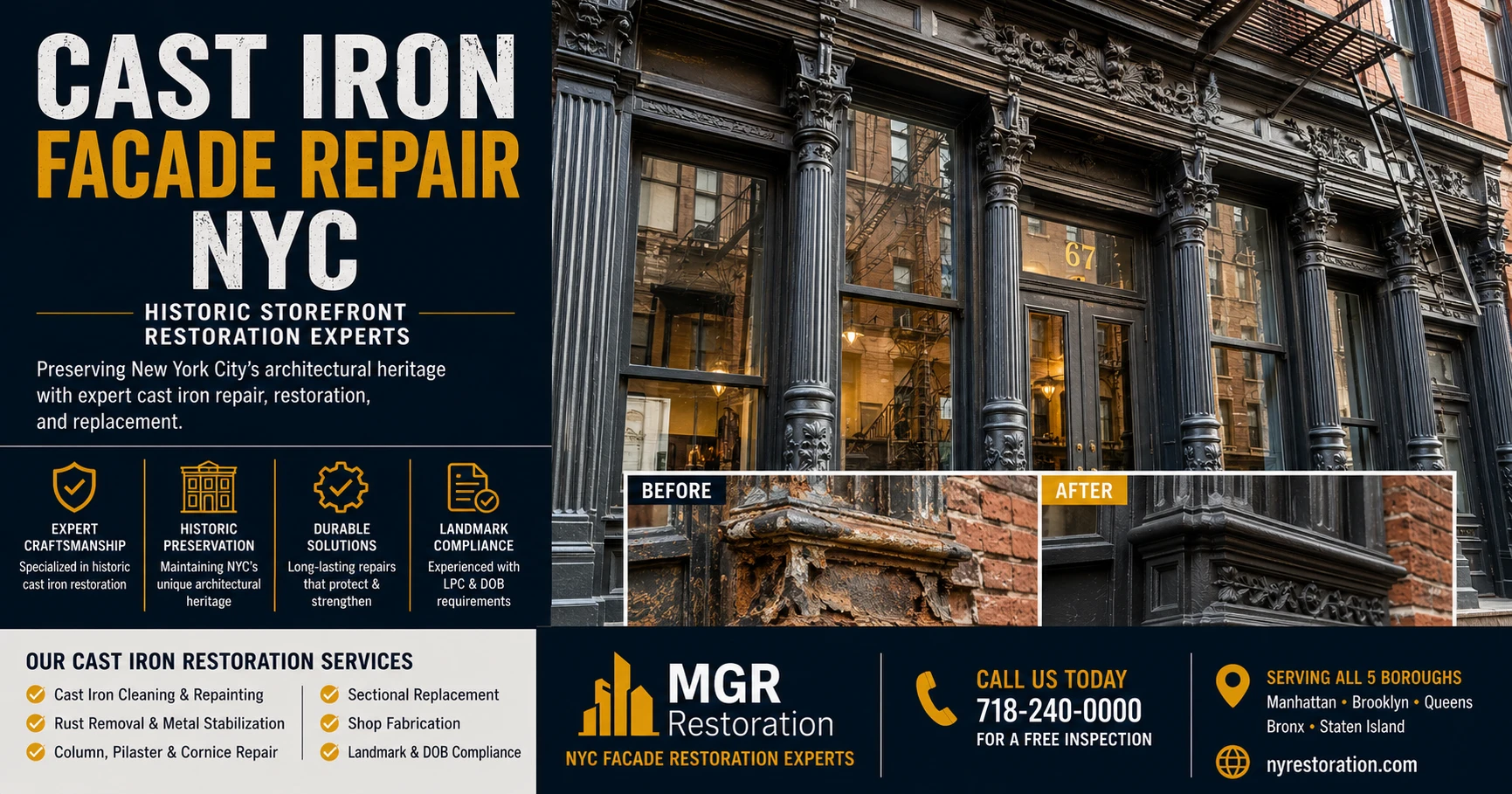
Cast iron architecture represents one of New York City’s most distinctive and historically significant building traditions. Born out of the Industrial Revolution, cast iron facades transformed the face of mid-19th century Manhattan — enabling architects to create elaborate, ornate storefronts and commercial buildings with a speed, cost-effectiveness, and decorative richness that traditional masonry could not match.
Cast iron is a form of iron with a high carbon content that is melted and poured into molds — allowing complex decorative shapes to be mass-produced with extraordinary precision. Applied to building facades, this meant that columns, pilasters, arches, cornices, window surrounds, and ornamental panels could be fabricated in repeating units and assembled on-site with remarkable efficiency.
The Cast Iron Era in NYC ran from approximately the 1840s through the 1880s — a period that coincided with New York’s explosive commercial growth and the development of SoHo, Tribeca, and the Ladies’ Mile shopping district. During this time, cast iron storefronts and multi-story commercial facades became the defining architectural expression of NYC’s booming mercantile economy.
Today, thousands of cast iron buildings survive in New York City — many in designated Historic Districts — representing an irreplaceable piece of the city’s architectural and cultural heritage. MGR Restoration is proud to be among the small number of NYC contractors with the specialist expertise, equipment, and AWS-licensed welders required to properly restore these extraordinary structures.
Where Is Cast Iron Found in NYC?
Cast iron facades are concentrated in several key neighborhoods and districts across Manhattan and Brooklyn:
SoHo Cast Iron Historic District
The most famous and extensive collection of cast iron architecture in the world. SoHo’s cast iron buildings — stretching across roughly 26 blocks of lower Manhattan — are the architectural jewels of the neighborhood. Many are individually landmarked and virtually all are within the SoHo-Cast Iron Historic District, regulated by the NYC Landmarks Preservation Commission (LPC).
Tribeca
Adjacent to SoHo, Tribeca contains numerous cast iron commercial loft buildings from the same era — many now converted to high-end residential use. The Tribeca North, South, East, and West Historic Districts protect much of this stock.
Flatiron & Ladies’ Mile
The Flatiron District and the former Ladies’ Mile shopping district contain significant concentrations of cast iron storefronts and building bases — many integrated into later masonry buildings as ground-floor commercial fronts.
Brooklyn
Brooklyn has its own cast iron heritage — particularly in DUMBO, downtown Brooklyn, and along portions of Fulton Street. Cast iron elements are also found on storefronts and building bases throughout Bedford-Stuyvesant, Crown Heights, and other historic neighborhoods.
Scattered Throughout Manhattan
Cast iron storefronts, building bases, and decorative elements appear throughout Manhattan — in the Financial District, the East Village, the Lower East Side, and many other neighborhoods — often as integrated elements of otherwise masonry buildings.
If your building has an ornate metal storefront, decorative columns, elaborate cornices, or detailed window surrounds that appear to be metal rather than stone, there is a strong chance you have cast iron — and it deserves specialist assessment and care.
Why Does Cast Iron Deteriorate in NYC?
Despite its strength and durability, cast iron is vulnerable to a specific set of deterioration mechanisms — all of which are accelerated by NYC’s climate and urban environment.
Corrosion (Rust)
Cast iron corrodes when exposed to oxygen and moisture — forming iron oxide (rust) that expands and physically damages the surrounding material. Unlike steel, which corrodes relatively uniformly, cast iron corrodes in a more complex pattern related to its crystalline structure. Surface rust is the first stage; if left untreated, it progresses to pitting, section loss, and eventually structural failure.
In NYC’s climate — with 46+ inches of annual rainfall, high summer humidity, and salt air in coastal neighborhoods — cast iron facades that are not properly maintained and painted develop active corrosion within just a few years.
Mechanical Damage
Cast iron is strong in compression but brittle in tension — meaning it can crack or fracture from impact, thermal shock, or structural movement in ways that steel would not. Vehicle impacts on ground-floor storefronts, construction vibration from adjacent projects, and decades of differential thermal expansion can all cause cracking and fracture of cast iron elements.
Failed Paint & Coatings
The primary defense against cast iron corrosion is a properly applied and maintained paint and primer system. When paint fails — through age, improper preparation, or incompatible products — moisture reaches the bare iron and corrosion begins immediately. In NYC’s exposed urban environment, exterior cast iron paint systems require maintenance every 5–10 years.
Joint & Connection Failures
Cast iron facades are assembled from individual units — columns, panels, cornices — connected with bolts and pins and sealed with caulking. As connections corrode and caulking fails, water infiltrates behind the cast iron, reaching both the iron itself and the masonry backup wall behind it. This hidden water infiltration can cause damage that is not visible until a section of facade becomes structurally unstable.
Deferred Maintenance
Many NYC cast iron buildings have not had proper maintenance in decades. Small cracks go unrepaired. Paint is allowed to fail. Water infiltrates and corrodes connections. What began as a minor surface issue develops into a complex structural repair — at dramatically higher cost than early intervention would have required.
Common Cast Iron Facade Problems in NYC Buildings
Surface Rust & Corrosion
The most common and earliest-stage problem — rust forming on the exposed surface of cast iron elements where paint has failed. Surface rust must be treated promptly before it progresses to more serious pitting or section loss.
Pitting & Section Loss
Advanced corrosion causes pitting — localized deep corrosion that reduces the cross-sectional area of the cast iron. Significant section loss compromises the structural capacity of the element and requires repair or replacement.
Cracked & Fractured Cast Iron
Impact damage, thermal movement, or structural settling can cause cast iron elements — particularly columns, panels, and ornamental details — to crack or fracture. Because cast iron is brittle, cracks tend to propagate rapidly if not addressed. Fractured cast iron is both a structural concern and a potential falling hazard.
Failed Joints & Open Connections
The bolted and pinned connections between cast iron units, and the caulked joints between cast iron and adjacent masonry, deteriorate over time. Open joints allow water infiltration behind the facade — causing corrosion of the iron and damage to the masonry backup wall.
Displaced or Bowing Elements
When the structural connections between cast iron elements and the building frame corrode or fail, individual panels, columns, or decorative elements can become displaced or begin to bow outward from the wall plane. This is a serious falling hazard requiring immediate attention.
Missing Elements
Pieces of cast iron ornament — finials, decorative brackets, panel sections, column capitals — are sometimes missing, either lost to damage or removed in previous inappropriate repair attempts. Missing elements compromise both the appearance and the structural integrity of the facade system.
Masonry Backup Wall Deterioration
Behind the cast iron facade, there is typically a masonry backup wall — brick or stone construction that provides the structural support for the iron cladding. Water that infiltrates through failed joints or corroded connections damages this backup wall through the same mechanisms — mortar joint failure, brick spalling, lintel corrosion — that affect any NYC masonry facade. Comprehensive cast iron restoration always includes assessment and repair of the backup wall.
⚠️ Safety Warning: Displaced, cracked, or structurally compromised cast iron elements on upper floors are a serious falling hazard. If you observe any bowing, cracking, or displacement of cast iron elements on your building, contact MGR Restoration immediately and consider installing a protective sidewalk shed until a professional assessment can be completed.
Is Cast Iron Facade Repair a Safety & Legal Issue in NYC?
Safety
Cast iron facades on upper floors — cornices, column capitals, panel sections — can weigh hundreds of pounds. When structural connections fail or elements crack, the risk of sections falling to the street below is real and serious. NYC has seen cast iron cornice failures that caused significant property damage and personal injury. This is not a theoretical risk.
Local Law 11 — Legal Compliance
For buildings six stories and taller, cast iron facades are subject to the same Local Law 11 (FISP) inspection and repair requirements as any other facade material. A Qualified Exterior Wall Inspector (QEWI) assessing a building with cast iron facade elements will evaluate:
- Evidence of active corrosion and section loss
- Cracking or fracture of cast iron elements
- Displaced or bowing panels, columns, or ornament
- Failed joints and connections
- Condition of the masonry backup wall behind the cast iron
Cast iron conditions that are structurally compromised will result in SWARMP or Unsafe ratings — triggering mandatory repair requirements and, for Unsafe conditions, immediate sidewalk shed installation.
Our team works directly alongside QEWI inspectors to execute all required cast iron repairs within DOB compliance timelines. Learn more about Local Law 11 & FISP facade inspections and how the compliance process works.
Cast Iron Facade Repair Methods We Use
Effective cast iron repair requires a combination of metalwork expertise, material science knowledge, and historic preservation sensibility. MGR Restoration brings all three to every cast iron project.
Rust Removal & Surface Preparation
Before any repair or coating work, we remove all existing rust and deteriorated paint through a combination of mechanical methods — power tool cleaning, needle scaling, wire brushing — and chemical rust converters where appropriate. Proper surface preparation is the single most important factor in the longevity of cast iron repairs and protective coatings.
For large-scale projects, we use abrasive blasting in controlled conditions to achieve a near-white metal surface — the preparation standard required for high-performance coating systems.
Metal-Filled Epoxy Patching
For surface pitting, minor section loss, and small cracks where welding is not practical or appropriate, we use metal-filled epoxy compounds — two-part structural epoxies with iron or steel filler that bond to the cast iron surface, fill voids, and restore the surface profile. Properly applied, these materials are extremely durable and can be shaped, sanded, and painted to be virtually invisible.
Crack Sealing & Consolidation
For fine cracks that do not affect structural capacity, we inject flexible epoxy or polyurethane sealants to seal against water infiltration and prevent crack propagation — extending the life of the element without requiring welding or replacement.
Connection & Joint Repair
We replace corroded bolts and pins with stainless steel hardware, clean and reseal open joints between cast iron units, and restore caulked joints at transitions to adjacent masonry — using sealants appropriate for metal-to-masonry applications.
Anchor & Tie Repair
Where cast iron elements have become displaced due to failed connections to the backup structure, we install new stainless steel anchors and ties — restoring the structural connection between the cast iron facade and the building frame without requiring full element removal.
Cast Iron Welding — Why It Requires Specialist Expertise
Welding cast iron is one of the most specialized skills in the building restoration field — and one of MGR Restoration’s core competencies. Not all welders can weld cast iron, and attempting to weld it without the right technique, equipment, and expertise almost always results in cracking.
Why Cast Iron Is Difficult to Weld
Cast iron’s high carbon content makes it extremely sensitive to thermal shock. When cast iron is heated rapidly for welding and then cools quickly, the sudden temperature change causes internal stresses that crack the metal — often right next to the weld. This is why so many cast iron repair attempts by unqualified contractors result in additional cracking rather than a repair.
MGR Restoration’s Cast Iron Welding Capability
Our approach to cast iron welding includes:
Preheating: We own and operate a large furnace specifically for preheating cast iron pieces before welding. Preheating the entire element — or as much of it as possible — to 500–1200°F before welding dramatically reduces thermal shock and the risk of cracking.
AWS Licensed Welders: Our welders hold AWS (American Welding Society) certifications and have specific experience with cast iron welding techniques — including the use of nickel-based welding rods appropriate for cast iron, controlled heat input, and slow post-weld cooling.
Stud Welding: For cracks that cannot be fully addressed by conventional welding, we use stud welding techniques — inserting studs across the crack line to mechanically bridge and reinforce it.
Post-Weld Treatment: After welding, we allow cast iron to cool slowly — often using insulating blankets — to prevent post-weld cracking. We then grind, shape, and finish the weld to match the surrounding surface profile.
This level of expertise and equipment is not common in the NYC contractor market. Building owners with cast iron facades should always verify that their contractor has specific cast iron welding experience — not just general welding capability.
Cast Iron Replacement & Custom Fabrication in NYC
When cast iron elements are too damaged for repair — completely fractured, missing, or suffering from advanced section loss — replacement is required. This is where cast iron restoration becomes truly specialized and where MGR Restoration’s national supply connections become critical.
Sourcing Salvaged Cast Iron
For common profiles and ornamental patterns, salvaged cast iron from demolition projects can sometimes be sourced and installed to replace damaged units. MGR Restoration maintains connections with salvage specialists and architectural antique dealers who can source period-appropriate cast iron elements.
Custom Cast Iron Fabrication
When salvage is not available, replacement elements can be custom fabricated. The process involves:
Documentation & Pattern Making: We precisely measure and document the profile, dimensions, and surface pattern of the element to be replicated — using the surviving original as the template.
Pattern Creation: A pattern is created — traditionally in wood or modern CNC-milled materials — that exactly replicates the original element’s geometry.
Foundry Casting: The pattern is used to create a sand mold into which molten cast iron is poured. After cooling, the casting is removed, cleaned, and finished.
Fitting & Installation: The new casting is fitted, adjusted as needed, and installed using appropriate hardware and sealants.
MGR Restoration’s connections with steel and foundry businesses across the country allow us to source custom fabricated elements efficiently and cost-effectively — even for historically specific profiles that are no longer in standard production.
Alternative Materials
In some cases — particularly where LPC approval allows — replacement elements can be fabricated from alternative materials such as glass fiber reinforced concrete (GFRC), fiberglass, or aluminum. These alternatives can reduce cost and weight but require LPC review for landmarked buildings and may not be appropriate for all applications.
Painting & Protective Coatings for Cast Iron Facades
Paint is not cosmetic on cast iron — it is structural protection. Without an intact, properly applied paint system, cast iron corrodes actively in NYC’s climate. Coating selection, surface preparation, and application technique are all critical to the longevity of the protective system.
The Correct Coating System for Cast Iron
A properly specified cast iron coating system consists of:
Primer: A zinc-rich or alkyd primer applied directly to the clean metal surface — providing both adhesion and sacrificial corrosion protection.
Intermediate Coat: A high-build intermediate coat that fills minor surface imperfections and provides film thickness for long-term protection.
Finish Coat: A durable topcoat — typically a high-quality alkyd, acrylic, or elastomeric finish — in a color appropriate to the building and, for landmarked buildings, approved by the LPC.
Elastomeric Coatings
For cast iron facades with complex surface profiles and fine surface cracks, elastomeric coatings such as Elastometal® provide excellent protection. These flexible coatings bridge hairline cracks, conform to the complex surface profiles of ornamental cast iron, and provide superior weather resistance compared to conventional paints. MGR Restoration uses Elastometal® and similar high-performance elastomeric systems on appropriate cast iron projects.
Maintenance Schedule
Even the best paint system requires maintenance. In NYC’s exposed urban environment, we recommend:
- Visual inspection every 2–3 years
- Touch-up of failed areas as they appear
- Full recoating every 7–12 years depending on exposure
Our painting and restoration team provides exterior painting and protective coating services for cast iron facades as part of comprehensive restoration projects.
Cast Iron Repair for NYC Landmark Buildings
The overwhelming majority of NYC’s cast iron buildings are located within Historic Districts or are Individual Landmarks designated by the NYC Landmarks Preservation Commission (LPC). This means that virtually all exterior repair and restoration work on cast iron buildings requires LPC approval before work begins.
LPC Requirements for Cast Iron Repair
- Repair methods must be appropriate for the historic material — welding, epoxy, and approved hardware are generally acceptable
- Replacement elements must match the original in profile, dimensions, surface texture, and material where possible
- Paint colors must be appropriate to the historic character of the building — LPC maintains color palettes for historic building types
- Elastomeric and other coating systems require LPC product review
- Documentation of existing conditions and proposed repairs must be submitted with the application
Navigating the LPC Process
MGR Restoration has extensive experience preparing and submitting LPC applications for cast iron restoration projects — particularly in SoHo and Tribeca, where the complexity of cast iron facades and the rigor of LPC review are both at their highest.
We prepare complete application packages — condition documentation, scope of work descriptions, material specifications, and sample submissions — that minimize the back-and-forth with LPC reviewers and get approvals as efficiently as possible.
💡 Pro Tip: LPC approval for cast iron projects — particularly those involving replacement elements or custom fabrication — can take 8–16 weeks. If you are also under a FISP compliance deadline, engaging MGR Restoration early to begin the LPC process is essential to avoiding conflicts between the two timelines.
Local Law 11 / FISP & Cast Iron Facades
For buildings six stories and taller in New York City, cast iron facade conditions are assessed as part of Local Law 11 (FISP) compliance. Understanding how FISP applies to cast iron is important for any building owner with this facade type.
FISP Inspection of Cast Iron Facades
A QEWI inspecting a cast iron building evaluates:
- Structural integrity of cast iron elements — columns, panels, cornices, ornamental details
- Corrosion level — surface rust vs active pitting vs section loss
- Crack and fracture conditions — location, length, and structural significance
- Connection and anchor conditions — evidence of corrosion or displacement
- Backup wall condition — masonry behind the cast iron assessed for water damage and structural integrity
Common FISP Outcomes for Cast Iron Buildings
Safe: Cast iron in generally sound condition with only minor surface rust or hairline cracking. Routine maintenance recommended.
SWARMP: Active corrosion, cracking, or failed connections present but not immediately dangerous. Repairs required within the next filing cycle — approximately 5 years. For cast iron buildings, SWARMP conditions require a documented repair and maintenance program.
Unsafe: Displaced, cracked, or structurally compromised cast iron elements that pose a falling hazard. Immediate sidewalk shed installation required and repairs must be completed on an emergency timeline.
👉 Learn more about SWARMP vs Unsafe NYC facade ratings and what each means for your building.
👉 Read our guide on how to choose a QEWI inspector in NYC.
Our Cast Iron Facade Repair Process Step by Step
Step 1 — Condition Assessment
We conduct a thorough close-up inspection of all cast iron facade elements — sounding for hollow conditions, probing joints, assessing corrosion levels, documenting cracks and displaced elements, and evaluating the backup wall condition. All findings are photographed and documented in a written assessment report.
Step 2 — Scope Development & Estimate
Based on the assessment, we develop a detailed written scope of work — identifying every element requiring repair, the recommended repair method for each, and an itemized cost estimate. For FISP-related projects, we coordinate with your QEWI to ensure our scope addresses all flagged conditions.
Step 3 — LPC Filing (for Landmark Buildings)
For buildings in Historic Districts or with Individual Landmark status, we prepare and submit the complete LPC application — including condition documentation, scope descriptions, and material specifications.
Step 4 — Permitting
We handle all required NYC DOB permits for the work — including scaffold permits, street closing permits where required, and any other applicable permits.
Step 5 — Access Setup
For cast iron restoration on buildings above the ground floor, we install scaffolding or suspended scaffold systems to safely access the full facade. For high-rise buildings, swing stage suspended scaffolds allow access to every level of the cast iron facade.
Step 6 — Surface Preparation
We remove all loose paint, rust, and contamination from all surfaces to be repaired or recoated — using power tools, chemical treatments, or abrasive blasting as appropriate.
Step 7 — Structural Repairs
We execute all structural repairs — welding cracks, replacing connections, installing anchors, epoxy patching, replacing missing elements — in the sequence that maintains safe conditions throughout the project.
Step 8 — Masonry Backup Wall Repairs
We repair the masonry backup wall — repointing deteriorated mortar joints, replacing damaged brick, repairing lintels, and installing flashings — as part of the comprehensive facade restoration.
Step 9 — Priming & Painting
We apply the complete primer, intermediate, and finish coat system — using appropriate products for cast iron and, for landmark buildings, colors and products approved by the LPC.
Step 10 — Final Inspection & Certification
We conduct a final inspection of all completed work. For FISP projects, a licensed engineer certifies the completed repairs and files the amended FISP report with the NYC Department of Buildings.
Cast Iron Facade Repair Costs in NYC
Cast iron restoration costs vary significantly based on the extent of corrosion and damage, the complexity of ornamental profiles, access requirements, and whether LPC approval and custom fabrication are needed.
| Scope | Estimated Cost Range |
|---|---|
| Rust removal & repainting (per sq ft) | $8 – $20 per sq ft |
| Epoxy patching & surface repair (per element) | $300 – $1,500 per element |
| Crack sealing & joint repair (per linear ft) | $30 – $100 per linear ft |
| Cast iron welding (per crack/fracture) | $500 – $3,000 per repair |
| Connection & anchor replacement (per connection) | $200 – $800 per connection |
| Custom cast iron fabrication (per element) | $2,000 – $15,000+ per element |
| Salvaged element sourcing & installation | $500 – $5,000 per element |
| Full storefront restoration | $15,000 – $80,000+ |
| Full multi-story cast iron facade restoration | $100,000 – $1,000,000+ |
| LPC documentation & filing | $3,000 – $12,000+ |
All figures are general estimates. Every cast iron project is unique. Contact MGR Restoration for a free site assessment and written estimate.
👉 Request a free cast iron repair estimate
FAQs
Get a Free Cast Iron Facade Assessment in NYC
Whether you manage a SoHo loft building with a deteriorating cast iron storefront or a landmark commercial building with upper-floor cast iron elements in need of structural repair, MGR Restoration has the specialist expertise, AWS-licensed welders, and LPC experience to restore it properly.
📞 Call now: 718-240-0000
🌐 Schedule a free assessment
🔧 View all services
📍 Serving Manhattan · Brooklyn · Queens · The Bronx · Staten Island
📍 Specialists in SoHo, Tribeca, DUMBO & NYC Historic District cast iron buildings
📍 48-11 69th Street, Woodside NY 11377 | contact@nyrestoration.com