If you own a building in New York City that’s six stories or taller, the NYC Department of Buildings (DOB) will give your facade one of three ratings every five years under the Façade Inspection & Safety Program (FISP):
- Safe
- SWARMP — Safe With a Repair and Maintenance Program
- Unsafe
Most NYC building owners understand “Safe” and “Unsafe.” But SWARMP is the rating that confuses co-op boards, condo associations, and landlords across Manhattan, Brooklyn, Queens, The Bronx, and Staten Island — and ignoring it is one of the most expensive mistakes you can make.
Here’s exactly what each rating means, what it costs, and what your building should do next.
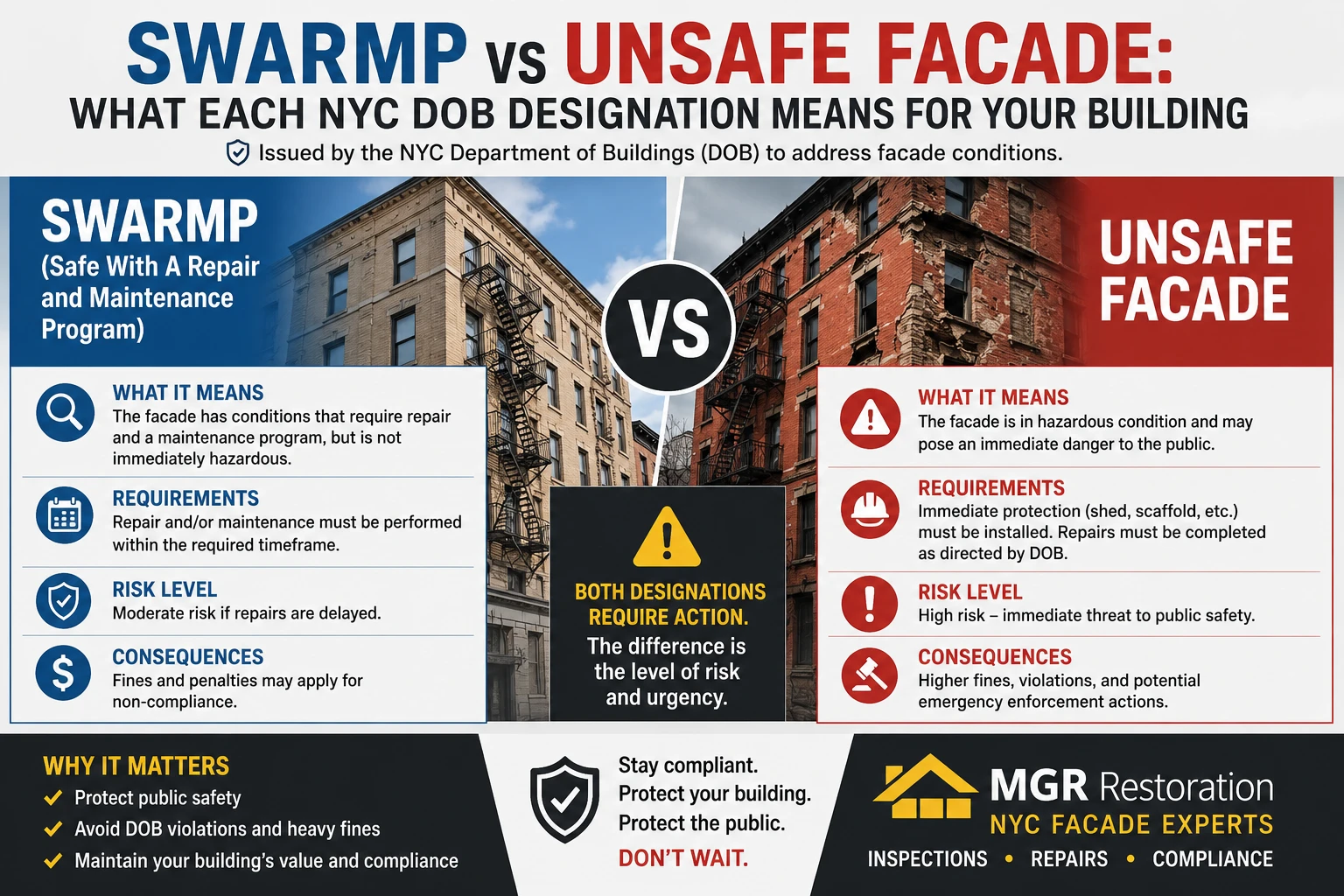
Quick Comparison: SWARMP vs Unsafe in NYC
| SWARMP | Unsafe | |
|---|---|---|
| Meaning | Safe today, needs repairs before next cycle | Immediate hazard to the public |
| Sidewalk shed required? | No | Yes — within 30 days |
| Repair deadline | Before next FISP cycle filing | 90 days (extensions possible) |
| Initial penalty | None at first | $1,000–$5,000 base ECB fine |
| Penalty for inaction | $2,000/month after deadline | $1,000/month + LL51 fines up to $20,000 |
| Auto-reclassifies? | Yes — to Unsafe at next cycle | N/A |
| Affects condo/co-op financing? | Yes — many lenders refuse | Yes — most lenders refuse |
What Does SWARMP Mean for Your NYC Building?
SWARMP stands for “Safe With a Repair and Maintenance Program.”
In plain English: your facade isn’t dangerous right now, but the QEWI (Qualified Exterior Wall Inspector) found conditions that will become dangerous within the next five years if you don’t fix them. The NYC DOB defines a SWARMP condition as one that’s safe at the time of inspection but requires repair or maintenance during the next five years — and not less than one year — to prevent it from becoming Unsafe.
Common SWARMP findings on NYC buildings:
- Hairline cracks in brick or limestone facades
- Mortar joint deterioration (calls for repointing or tuckpointing)
- Minor terra cotta or stone spalling
- Worn caulking or sealant joints
- Surface-level water infiltration
- Minor parapet displacement
- Early-stage steel lintel rust
If your building gets a SWARMP rating, the QEWI sets a specific repair deadline for each item — usually within 1 to 5 years. You don’t need a sidewalk shed, you don’t get an immediate fine, and you can take a planned, budgeted approach to repairs.
But here’s the trap: SWARMP conditions automatically reclassify to Unsafe at the next cycle if they aren’t fixed. That’s not a discretionary call by the DOB. It’s automatic. A SWARMP condition that was minor in 2026 becomes a $1,000-per-month Unsafe violation in 2031 — even if the actual physical condition hasn’t gotten any worse.
This is why proactive masonry restoration and facade repair work between cycles is the cheapest way to manage SWARMP findings on NYC buildings.
What Does Unsafe Mean for Your NYC Building?
An Unsafe rating means the QEWI identified a condition that’s actively hazardous to people or property and requires repair within one year. The NYC DOB takes this rating seriously, and so should you.
Common Unsafe findings on NYC buildings:
- Loose or displaced bricks at risk of falling
- Bulging or detaching facade sections
- Cracked or shifted parapet walls
- Severely corroded steel lintels causing brick displacement
- Spalling concrete on balconies or terraces
- Fractured terra cotta or stonework
- Loose decorative elements above pedestrian areas
The moment a QEWI identifies an Unsafe condition, they file a FISP3 form — a Notification of Unsafe Conditions — directly with the DOB. A DOB inspector often visits within 24 hours.
What happens next:
- Sidewalk shed required within 30 days. If your facade fronts a public right-of-way, you must install a sidewalk shed and protective scaffolding immediately.
- Repairs must be completed within one year (90 days for the most urgent conditions). Extensions are possible but require active work documentation.
- Wall Certificate posted publicly showing your Unsafe rating.
- Facade repairs must be performed by qualified contractors and signed off by a registered design professional before the rating can be amended.
The financial impact is significant. A typical Unsafe NYC building pays:
- $30,000 – $100,000+ per year in sidewalk shed rental fees
- $50,000 – $1,000,000+ in repair costs depending on building size and damage
- $1,000+ per month in DOB penalties if repairs aren’t made on time
- $5,000 – $20,000 in additional Local Law 51 fines (effective January 12, 2026) if a sidewalk shed sits up without active repair work
- Lost property value and lender resistance — many NYC banks won’t refinance or approve sales for buildings with Unsafe ratings
SWARMP Auto-Reclassification: The Hidden Trap
This is the part most NYC co-op boards miss until it’s too late.
Under NYC DOB Rule 1 RCNY § 103-04, any SWARMP condition that wasn’t repaired in the previous cycle must be reported as Unsafe in the current cycle’s FISP report — automatically, regardless of physical danger.
Example: Your Brooklyn brownstone was rated SWARMP in 2021 (Cycle 9) for hairline cracks in the parapet. Your board put off the repairs. Now it’s 2026, your block number puts you in Sub-cycle 10B, and the QEWI is back. Even if those cracks haven’t grown at all, the law requires they be filed as Unsafe.
The result:
- Sidewalk shed goes up within 30 days
- Repairs must be completed within a year
- $2,000 civil penalty for each unrepaired SWARMP item
- Possible Local Law 51 fines on top
- Sale and refinancing restrictions
This is why we tell every NYC client the same thing: treat SWARMP findings like a deadline, not a recommendation. Fixing a SWARMP condition early is almost always 5–10x cheaper than dealing with the same condition after it’s been reclassified Unsafe.
How NYC Building Owners Should Handle Each Rating
If Your NYC Building Is Rated Safe
Your facade has no defects expected to become dangerous within five years. Post your Wall Certificate, file your report, and plan your maintenance schedule. The smartest NYC owners still budget annually for waterproofing and minor masonry restoration to stay Safe at the next inspection.
If Your NYC Building Is Rated SWARMP
- Read the QEWI report carefully — each item has its own repair deadline.
- Get firm bids for all SWARMP items together. Bundling repairs saves 15–25% versus piecemeal work.
- Schedule facade repairs at least 12–18 months before the next cycle deadline. Repair contractors fill up fast in the last 6 months of every sub-cycle.
- Address steel lintels, parapets, and water-infiltration items first — these escalate fastest into Unsafe conditions.
- File an amended report through DOB NOW: Safety once repairs are complete to update your status.
If Your NYC Building Is Rated Unsafe
- Install a sidewalk shed immediately if required. Don’t wait — penalties accrue daily.
- Hire experienced facade restoration specialists familiar with NYC DOB protocols. Our team handles full-scope Local Law 11 repairs including emergency Unsafe remediation across all five boroughs.
- File construction documents within 5 months and a work permit within 8 months (Local Law 51 of 2025 requirements).
- Address related conditions at the same time — when you have scaffolding up and a crew on-site, it’s far cheaper to also handle roofing, parapet, and waterproofing repairs.
- File an amended report once repairs are complete and certified, then remove the sidewalk shed.
Why NYC Buildings Get SWARMP and Unsafe Ratings
Most facade conditions in New York City come down to a few recurring causes:
- Freeze-thaw damage — NYC’s winter cycle expands water trapped in mortar joints, splitting brick and stone
- Rusting steel lintels — pre-war buildings throughout Manhattan, Brooklyn, and Queens have steel lintels above windows that rust and expand, cracking the brick above them
- Failed waterproofing — leaking parapets, copings, and roof flashings let water enter the wall assembly
- Deferred maintenance — buildings that skipped routine repointing or masonry restoration accumulate findings cycle after cycle
- Original construction defects — modern curtain wall systems can fail at sealants, anchors, or panel joints
The good news: every one of these causes is preventable with consistent maintenance. NYC buildings that invest in routine waterproofing, roofing repairs, and small-scale facade repairs between cycles consistently get Safe ratings — and avoid six-figure repair bills.
How a Trusted NYC Facade Contractor Helps You Manage Both Ratings
Whether your New York City building is rated SWARMP or Unsafe, the response is the same in one respect: you need an experienced facade restoration contractor who knows NYC DOB rules, can mobilize fast, and delivers compliant work that holds up at the next inspection.
MGR Restoration provides full-service support for both designations across Manhattan, Brooklyn, Queens, The Bronx, and Staten Island:
- Local Law 11 / FISP Repairs — SWARMP remediation and emergency Unsafe response for buildings throughout NYC
- Facade Repairs — Brick, stone, terra cotta, and curtain wall restoration for pre-war, mid-century, and modern NYC buildings
- Masonry Restoration — Repointing, brick replacement, and historic preservation for landmark and brownstone properties
- Waterproofing — Stops the water infiltration that causes most SWARMP findings in the first place
- Roofing — Parapet, coping, and flat roof work that eliminates a major source of facade damage
- Suspended Scaffold & FISP Inspections — Safe, code-compliant access for QEWI inspections and repair work
We work with co-op boards in Upper West Side and Park Slope pre-wars, condo associations in Tribeca and Long Island City high-rises, brownstone owners in Brooklyn Heights and Harlem, and commercial property managers across Midtown Manhattan and Downtown Brooklyn.
Don’t Let SWARMP Become Unsafe. Get Ahead of Your Next NYC Inspection.
The single biggest factor in what your next NYC FISP cycle costs is what you do between cycles. SWARMP conditions are warnings, not waivers. The longer you wait, the more expensive the fix becomes — and the higher your chances of an Unsafe rating, sidewalk shed, and DOB penalties.
Call MGR Restoration at 718-240-0000 or request a free facade assessment. We’ll review your current FISP rating, identify the SWARMP conditions most likely to escalate, and give you a clear plan to keep your building Safe at the next inspection.
Serving New York City and all five boroughs from our Woodside, Queens headquarters.
MGR Restoration Inc. is a licensed and insured New York City facade restoration contractor. This article reflects NYC DOB FISP requirements as of 2026. Building owners should consult a Qualified Exterior Wall Inspector for site-specific rating and repair guidance.