What Is a Lintel?
A lintel is a horizontal structural member that spans across the top of a window or door opening in a masonry wall. Its job is to carry the weight of the masonry above the opening — transferring that load to the solid wall on either side. Without a properly functioning lintel, the masonry above windows and doors would have nothing to support it.
In New York City’s brick and masonry buildings, lintels are almost universally made of steel — typically flat bar steel, steel angle, or built-up steel sections. Steel lintels were the standard choice for NYC construction throughout the 19th and 20th centuries because of their strength, availability, and cost-effectiveness.
The problem is that steel corrodes when exposed to moisture — and in NYC’s dense masonry buildings, the moisture reaches those lintels far more often than most building owners realize.
Rusting lintels are one of the most common and most consequential structural defects found in NYC brick buildings of all ages. MGR Restoration has replaced hundreds of corroded lintels across Manhattan, Brooklyn, Queens, the Bronx, and Staten Island. Here is everything you need to know.
Why Do Lintels Rust in NYC Buildings?
Steel lintels are embedded inside the masonry wall — typically just above window and door frames, hidden behind several inches of brick. They are not visible from the outside. So how does moisture reach them?
Failed Mortar Joints
As mortar joints between bricks deteriorate with age, they open hairline cracks that allow rainwater to penetrate the wall. Water that enters through failed joints above a window runs down through the wall assembly and contacts the steel lintel — beginning the corrosion process. This is why our masonry restoration specialists emphasize that regular repointing is the most important preventive maintenance for NYC brick buildings.
Failed Window Caulking
The caulk seal between window frames and surrounding masonry is a critical water barrier. When it cracks, shrinks, or pulls away — as it inevitably does after 10–15 years in NYC’s climate — rainwater has a direct path to the window head and the lintel above. Every rainstorm drives water through this joint and onto the steel.
Failed or Missing Flashings
Properly installed window head flashings intercept water that has penetrated the outer brick wythe and redirect it back out through weep holes — before it reaches the lintel. When these flashings corrode, detach, or were never properly installed, water runs directly onto the lintel with every rain event.
Age of the Building Stock
Most of NYC’s brick building stock was constructed between 1870 and 1960. The lintels in these buildings are 60–150 years old. Even if they have been relatively dry for most of that time, decades of occasional moisture exposure accumulates — and corrosion accelerates as more rust forms, holds more moisture, and drives further oxidation.
Improper Past Repairs
Ironically, some of the worst lintel corrosion we see is associated with previous repair work. When hard Portland cement mortars are used in repointing work on older buildings, the cement traps moisture inside the wall rather than allowing it to evaporate — keeping the lintel in a chronically damp environment that accelerates corrosion.
Warning Signs of Rusting Lintels You Should Never Ignore
Because lintels are hidden inside the wall, the signs of their corrosion appear on the wall surface and around window openings — not on the lintel itself. Knowing what to look for allows you to catch lintel corrosion before it reaches an emergency stage.
Rust Staining on the Facade
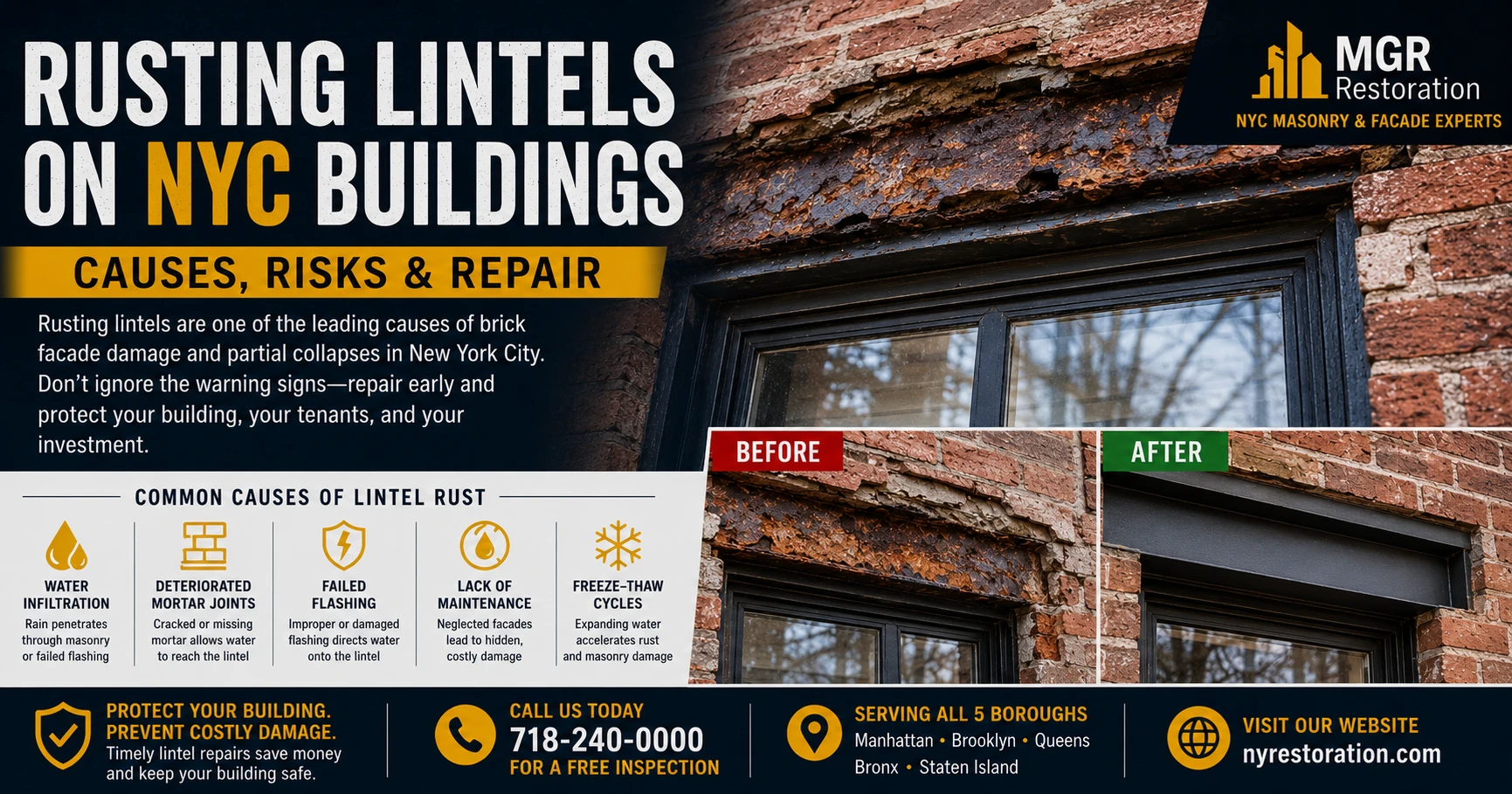
The most visible and immediate sign. As the lintel corrodes, rust bleeds through the masonry above the window — creating brown, orange, or reddish staining that runs down the face of the building from the window head. This staining is not cosmetic — it is the visible evidence of an active corrosion process happening inside the wall.
Stair-Step Cracks Above Windows
As corroding steel expands inside the wall, it pushes outward against the surrounding masonry. This creates characteristic diagonal or stair-step cracking patterns in the brick above window openings — following the mortar joints as the expanding steel forces the masonry apart.
Horizontal Cracks at the Lintel Level
A horizontal crack running along the bed joint immediately above the window frame — at the level of the lintel — indicates the steel is expanding and pushing the masonry upward and outward. This is a more advanced sign of corrosion requiring prompt action.
Displaced or Bowed Brick Above Windows
When lintel corrosion is advanced, the expanding steel can push individual bricks outward — causing them to bow or displace from the plane of the wall. Displaced bricks above windows are a potential falling hazard and a clear sign that the lintel has failed structurally.
Spalling Brick Around Windows
Freeze-thaw cycling of water that has entered through a deteriorated lintel zone causes the surrounding brick to spall — with faces breaking away from the brick body. Concentrated spalling around window openings, particularly at the head, strongly suggests lintel corrosion is contributing.
Interior Water Staining Above Windows
Water that has entered through a failed lintel zone often appears as staining on interior walls directly above window frames. If you see water stains or damp plaster on the inside of exterior walls above windows — particularly after rain — lintel corrosion is a likely contributor.
⚠️ Do not ignore rust staining above your windows. What appears as a cosmetic stain is the visible signal of steel corrosion actively expanding inside your wall. Left untreated, the expanding steel will crack and displace the surrounding masonry — creating a falling hazard and requiring far more extensive and expensive repairs than early intervention would have cost.
How Serious Is Lintel Corrosion — Is It a Structural Emergency?
The answer depends on the stage of corrosion — but the trajectory is always toward becoming more serious over time.
Early Stage — Cosmetic Staining Only
Rust staining visible on the facade but no cracking or displacement of masonry. The lintel is corroding but has not yet expanded enough to physically move the surrounding masonry. Action required: professional assessment and monitoring at minimum; proactive lintel replacement strongly recommended.
Moderate Stage — Cracking Without Displacement
Stair-step or horizontal cracks visible above the window, with rust staining. The lintel has expanded enough to crack the mortar joints but not yet displaced solid masonry units. Action required: lintel replacement within one construction season.
Advanced Stage — Displaced or Bowed Masonry
Brick units above the window are displaced outward from the wall plane. The lintel has expanded significantly and the masonry above the window is no longer properly supported. This is a structural emergency requiring immediate action. Under Local Law 11, this condition would likely be classified as Unsafe, requiring immediate sidewalk shed installation and emergency repairs.
Failed Lintel — Masonry Collapse Risk
In extreme cases of deferred maintenance, the lintel has corroded through entirely, leaving the masonry above the window with no structural support. This is an imminent collapse risk. Call MGR Restoration immediately at 718-240-0000.
The key takeaway: lintel corrosion never improves on its own. Every year of delay means more corrosion, more masonry damage, and a higher repair bill. The cost difference between early-stage and advanced-stage lintel replacement can be $5,000–$20,000 per opening in additional masonry repair.
Types of Lintels Found in NYC Buildings
Not all lintels are the same — and the type of lintel affects both the corrosion risk and the repair approach.
Steel Angle Lintels
The most common type in NYC brick buildings. A single or double steel angle (L-shaped in cross section) is placed above the opening with the horizontal leg bearing on the masonry on each side. Steel angle lintels are simple, strong, and almost universally used in NYC construction from the late 19th century onward.
Flat Bar Lintels
Used in older buildings and for narrower openings. A flat bar of steel spans the opening — simpler and slightly less strong than angle lintels. Common in pre-1900 NYC construction.
Built-Up Steel Lintels
For wider openings — large windows, storefronts, garage doors — built-up steel sections combining multiple angles or plates provide the span capacity needed. These are more complex to replace but follow the same corrosion pattern.
Shelf Angles
Shelf angles are a related but distinct element — horizontal steel angles that run continuously along the facade at each floor level, supporting the weight of the brick veneer above. They are subject to the same corrosion as lintels and are often replaced as part of the same scope. Our facade repair specialists regularly replace both lintels and shelf angles in the same project.
Concrete Lintels
Some mid-century buildings use precast or cast-in-place concrete lintels. These do not corrode in the same way as steel but can crack, spall, and suffer from reinforcing bar corrosion — producing similar visible symptoms.
Stone Lintels
In older brownstone and limestone-clad buildings, original lintels may be stone — particularly brownstone or bluestone. Stone lintels crack from structural movement and age but do not corrode. Our stone repair specialists handle stone lintel repair and replacement as part of brownstone and masonry restoration scopes.
How Lintel Corrosion Progresses If Left Untreated
Understanding the progression of lintel corrosion helps building owners grasp why early action is so much less expensive than deferred repair.
Year 1–5 after first moisture contact: Rust forms on the steel surface. Rust staining may begin to appear on the facade. No cracking yet. Repair at this stage: lintel replacement plus minor masonry repair and recaulking — relatively straightforward.
Year 5–15: Rust layer thickens. Corroding steel begins to expand. First hairline cracks appear in mortar joints above the window. Rust staining more pronounced. Repair at this stage: lintel replacement plus crack repair and repointing of the affected zone — more work than early stage.
Year 15–25: Significant steel expansion. Stair-step cracks widen. Individual bricks begin to displace. Water infiltration through cracks increases, accelerating corrosion further — a self-reinforcing cycle. Repair at this stage: lintel replacement plus significant masonry repair, brick replacement, and waterproofing — substantially more expensive.
Year 25+: Advanced or complete lintel failure. Masonry above window may be actively unstable. Risk of masonry falling. At this stage, emergency shoring, extensive masonry rebuild, and potential interior damage repair are required alongside lintel replacement — the most expensive outcome by far.
The message is clear: a lintel that costs $2,000 to replace today may cost $15,000–$25,000 to address in ten years once the surrounding masonry damage is factored in.
Lintel Repair vs Lintel Replacement — Which Do You Need?
The straightforward answer: in almost all cases, lintel replacement is the correct approach — not repair.
Unlike masonry or stone, which can be patched and consolidated, a corroded steel lintel cannot be effectively repaired in place. Surface rust treatment and coating will not stop corrosion that has already penetrated the steel cross-section. Epoxy injection around a failed lintel does not restore its structural capacity.
Replacement is the only reliable solution — remove the failed lintel, install a new properly sized galvanized or stainless steel lintel, and repair the surrounding masonry.
The one situation where repair rather than replacement is considered is when rust staining has appeared but detailed investigation confirms the steel cross-section is still structurally sound — no significant section loss. In this case, the lintel may be treated, the water source sealed, and the surrounding masonry repaired with close monitoring for further progression. However, this is a temporary measure — replacement is the definitive solution.
How MGR Restoration Replaces Lintels in NYC
Lintel replacement is a skilled structural operation — not a simple masonry task. Here is our step-by-step process:
Step 1 — Assessment & Scope Definition
We inspect every window and door opening on the facade — looking for rust staining, cracking patterns, displaced masonry, and failed caulking. We identify every lintel requiring replacement and document the scope in a written report with photographs.
For buildings subject to Local Law 11 FISP inspections, we coordinate with your QEWI inspector to ensure our scope addresses all flagged conditions.
Step 2 — Access Setup
For brownstones and low-rise buildings, we set up standard scaffolding to safely access the lintel locations. For mid-rise and high-rise buildings, we install suspended scaffold systems — swing stages that allow access to the full building height.
Step 3 — Temporary Shoring
Before any masonry is removed above the window, we install temporary shoring to support the weight of the brick above the opening. This is a critical safety step — never skip it, and never hire a contractor who proposes to skip it.
Step 4 — Masonry Removal
We carefully remove the brick or stone directly above the window opening — the zone immediately overlying the lintel — preserving as much sound masonry as possible for reinstallation.
Step 5 — Failed Lintel Removal
The corroded lintel is removed in its entirety. We inspect the bearing areas on each side of the opening where the lintel rests on the solid wall — treating any corrosion found there before installing the new lintel.
Step 6 — New Lintel Installation
We install a new steel angle or built-up lintel — properly sized for the span and load — in hot-dip galvanized steel or stainless steel. Galvanized steel is standard; stainless steel is specified for particularly exposed or historically problematic locations.
Step 7 — Masonry Repair & Rebuilding
We reinstall salvaged brick above the new lintel where possible, supplemented with closely matched replacement brick where units are too damaged to reuse. The masonry is rebuilt to the original bond pattern and joint profile.
Step 8 — Repointing & Caulking
All mortar joints in the repaired zone are repointed with appropriate mortar. New caulk is installed at the window perimeter — addressing the water source that caused the original corrosion.
Step 9 — Final Inspection
We inspect the completed work, remove all shoring and temporary supports, and provide documentation for any required DOB or FISP filings.
Rusting Lintels & Local Law 11 / FISP Compliance
For NYC buildings six stories and taller, rusting lintels are one of the most common triggers for SWARMP or Unsafe ratings under Local Law 11 — the Facade Inspection Safety Program.
During a FISP inspection, a Qualified Exterior Wall Inspector (QEWI) looks specifically for:
- Rust staining on the facade above window openings
- Cracking patterns consistent with lintel expansion
- Displaced or bowed masonry at window heads
- Evidence of water infiltration at lintel locations
What Happens if Your Building Gets a FISP Violation for Lintels?
SWARMP rating: Your building has lintel conditions requiring repair, but they are not immediately dangerous. You have until the next FISP filing cycle — approximately 5 years — to complete repairs and have them certified by your QEWI.
Unsafe rating: Displaced masonry or other immediately hazardous conditions exist at lintel locations. You must install a sidewalk shed within 24 hours and complete repairs on an emergency timeline before the shed can be removed.
MGR Restoration responds quickly to both scenarios. We have mobilized emergency crews for Unsafe lintel conditions within 48 hours of being contacted — helping building owners get back into compliance as quickly as possible.
👉 Read our guide: How to Choose a QEWI Inspector in NYC
👉 Learn more: SWARMP vs Unsafe NYC Facade Ratings Explained
Lintel Replacement Cost in NYC
Lintel replacement costs vary based on lintel size, span, masonry damage extent, access requirements, and building height.
| Scope | Estimated Cost Range |
|---|---|
| Single lintel replacement — low-rise | $1,500 – $4,000 |
| Single lintel replacement — mid/high-rise | $2,500 – $6,000 |
| Multiple lintels (5–10 openings) | $10,000 – $35,000 |
| Full building lintel program (20+ openings) | $40,000 – $120,000+ |
| Lintel replacement + surrounding masonry repair | Add $1,000 – $8,000 per opening |
| Shelf angle replacement (per linear ft) | $80 – $200 per linear ft |
| Emergency Unsafe violation response | Premium of 20–40% on standard rates |
Cost-saving tip: When multiple lintels need replacement, doing them all in the same mobilization is significantly more cost-effective than doing them one at a time. Scaffold setup, shoring equipment, and crew mobilization costs are shared across all openings — reducing the per-lintel cost substantially.
All figures are general estimates. Contact MGR Restoration for a free, itemized written estimate for your building.
👉 Request a free lintel assessment
Landmark Buildings & Lintel Repair in NYC
For buildings in NYC Historic Districts or designated as Individual Landmarks, lintel replacement requires LPC (Landmarks Preservation Commission) approval before work begins.
Key LPC requirements for lintel replacement typically include:
- Replacement lintels must be the same size and profile as the original
- Galvanized steel is generally approved; stainless steel and painted steel may require review
- Replacement brick must closely match the original in color, size, and texture
- Mortar must be matched to the original in composition and color
- Documentation of existing conditions must be submitted
MGR Restoration prepares all required LPC documentation and filings as part of our project scope. Our experience with landmark masonry restoration — including our work on landmarked buildings across Brooklyn Heights, Park Slope, and Manhattan Historic Districts — means we understand LPC requirements thoroughly and prepare complete, accurate applications that minimize approval delays.
How to Prevent Lintel Corrosion in NYC Buildings
While no lintel lasts forever, the right maintenance program can dramatically extend lintel life and reduce the likelihood of emergency failures.
Keep Mortar Joints Repointed
Deteriorated mortar joints are the primary water pathway to embedded steel. Having your facade professionally repointed on a regular schedule — every 20–30 years, or when deterioration is visible — keeps water out of the wall assembly. Our masonry restoration team recommends annual facade inspections to catch mortar joint deterioration early.
Replace Window Caulking on Schedule
Window perimeter caulking lasts 10–15 years in NYC’s climate. Replacing it on a proactive schedule — rather than waiting until it fails — keeps one of the most direct water pathways to lintels sealed.
Maintain Flashings
Window head flashings intercept water before it reaches the lintel. Having flashings inspected every five years and replaced when signs of corrosion or detachment appear prevents significant water from reaching embedded steel.
Address Water Infiltration Signs Promptly
Any sign of water leaking through exterior brick walls — interior staining, efflorescence, damp plaster — should be investigated and repaired promptly. Water that is reaching your interior has almost certainly already contacted embedded steel elements including lintels.
Use Appropriate Mortar in Repairs
If you ever have repointing work done, insist on mortar that is softer than your brick or stone — lime-based mortars for older buildings. Hard Portland cement mortars trap moisture inside the wall and accelerate corrosion of embedded steel.
FAQs
Get a Free Lintel Assessment — All NYC Boroughs
Rust staining above your windows is not cosmetic — it is a warning sign that demands action. MGR Restoration provides fast, expert lintel assessment and replacement across all five boroughs of New York City.
📞 Call now: 718-240-0000
🌐 Schedule a free assessment
🔧 View all services
📍 Serving Manhattan · Brooklyn · Queens · The Bronx · Staten Island
📍 48-11 69th Street, Woodside NY 11377 | contact@nyrestoration.com