Is Water Leaking Through Your Brick Wall Normal?
No — water leaking through a brick wall is never normal, and it should never be ignored.
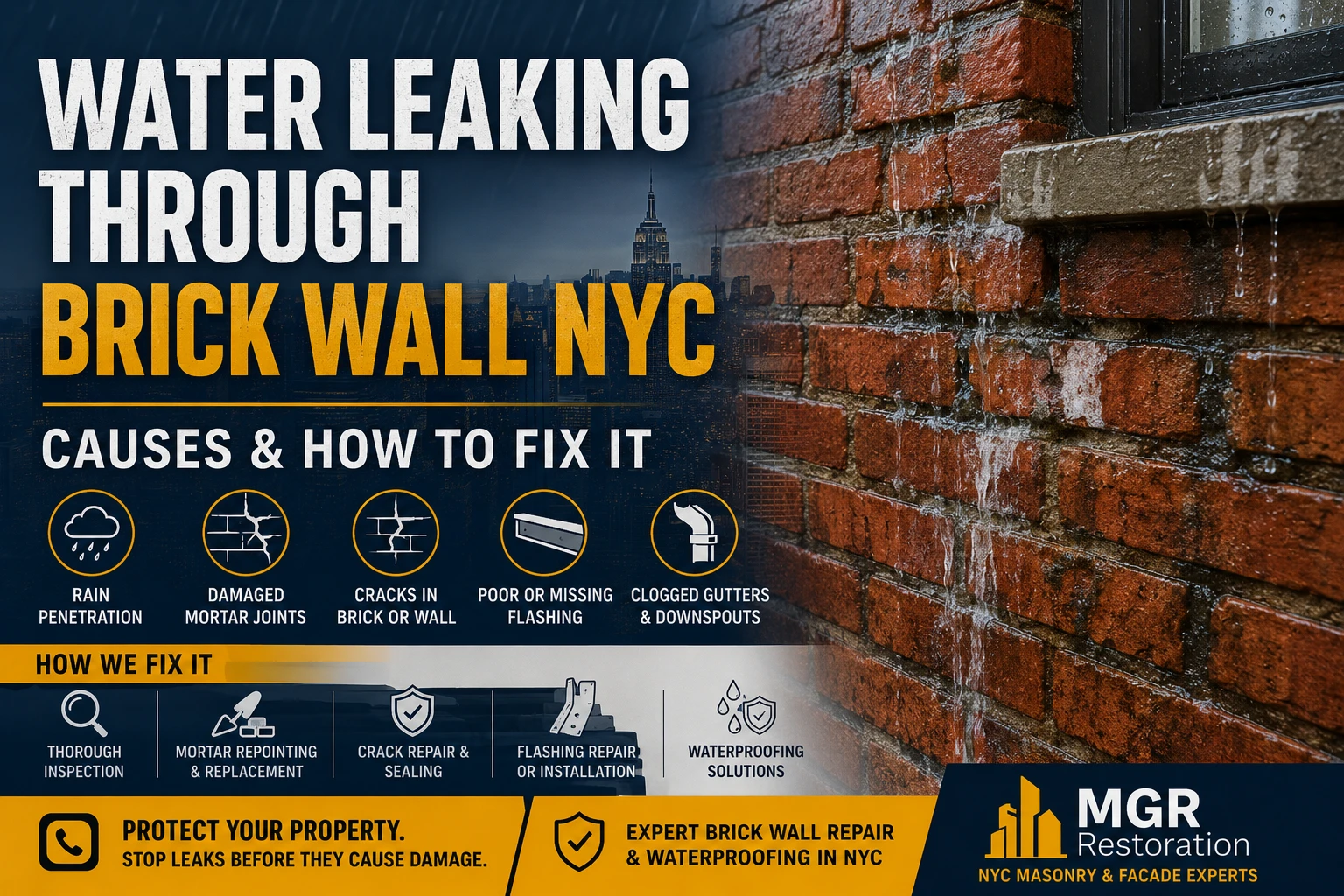
Brick walls are designed to manage water — they slow it down, drain it, and redirect it. But they are not impermeable. When the mortar joints fail, when cracks develop, or when the waterproofing systems built into the wall deteriorate, water finds its way through — and once inside, it causes damage that compounds quickly and expensively.
In New York City, water infiltration through brick walls is one of the most common building maintenance problems we encounter. NYC’s climate is particularly harsh — heavy rainfall, high humidity in summer, and brutal freeze-thaw cycles in winter create ideal conditions for water to exploit every weakness in a brick facade.
If you are seeing water stains on interior walls, damp plaster, peeling paint near windows, or actual water running down your interior brick, this guide will help you understand exactly what is happening and what needs to be done.
MGR Restoration has diagnosed and repaired brick wall water leaks on hundreds of NYC buildings across Manhattan, Brooklyn, Queens, the Bronx, and Staten Island. Here is everything you need to know.
How Does Water Get Through a Brick Wall?
Understanding how water travels through a brick wall helps you understand why the repair needs to address the source — not just the symptom.
Brick itself is porous. It absorbs some water, holds it, and releases it through evaporation when conditions dry out. This is normal and manageable as long as the wall system is functioning properly.
The problems begin when:
The mortar joints fail. Mortar is softer than brick and deteriorates faster. As mortar cracks, shrinks, or falls out, it creates open channels that allow water to enter the wall cavity — far beyond what the brick alone would absorb.
Cracks develop. Structural cracks, settlement cracks, or cracks from thermal movement create direct pathways for water — bypassing the masonry entirely.
Flashings fail. Flashings are thin metal or membrane barriers built into the wall at critical locations — window heads, sill transitions, parapet bases — to redirect water back out of the wall. When they corrode, detach, or are improperly installed, water pours directly into the wall assembly.
Caulking deteriorates. The sealant around windows, doors, and expansion joints is the front line of water defense. Caulking has a lifespan of 10–20 years. Failed caulking is one of the single most common causes of water infiltration in NYC brick buildings.
The brick face spalls. When freeze-thaw damage causes the face of bricks to break away, it exposes the more porous interior of the brick — dramatically increasing water absorption.
Most Common Causes of Brick Wall Water Leaks in NYC
Cause #1 — Failed Mortar Joints (Most Common)
This is the number one cause of water leaking through brick walls in New York City — and the most commonly overlooked.
Mortar joints between bricks are designed to be slightly softer than the brick itself — this allows the mortar to act as a sacrificial element, absorbing differential movement and weathering so the bricks do not crack. The downside is that mortar deteriorates faster. In NYC buildings, mortar joints typically need repointing every 20–40 years depending on exposure and original mortar quality.
When mortar joints crack, shrink, or erode, they create open channels directly into the wall. Water runs down the face of the building, hits these open joints, and flows directly inside.
Signs of failed mortar joints: Crumbling mortar you can pick out with your finger, visible gaps between bricks, horizontal lines of staining below mortar joint rows.
👉 Learn more about our Masonry Restoration & Brick Repointing services
Cause #2 — Cracked or Failed Window Caulking
The joint between your window frame and the surrounding brick masonry is sealed with caulk — a flexible sealant that accommodates slight movement between the rigid window frame and the brick wall. This caulking has a finite lifespan. In NYC’s climate, expect 10–15 years before it begins to crack, shrink, and separate.
Once the caulk fails, every rainstorm drives water directly through the joint and into the wall assembly. This is one of the fastest and most direct paths for water to reach your interior walls and window reveals.
Signs of failed window caulking: Visible cracks or gaps in the caulk bead around window frames, caulk that has pulled away from one or both sides, water staining directly below or beside windows on interior walls.
Cause #3 — Failed or Missing Flashings
Flashings are thin metal or membrane barriers installed at critical transitions in the wall — above windows (head flashings), at window sills (sill flashings), at the base of parapet walls, at roof-to-wall junctions, and at shelf angles. Their job is to intercept water that has entered the outer brick wythe and redirect it back out through weep holes.
When flashings corrode (typically after 20–40 years for lead or galvanized steel), detach from their substrate, or were improperly installed, water that would otherwise be safely redirected out of the wall instead flows directly into the building structure.
Flashing failure is a particularly serious cause of water infiltration because the water enters at height — often soaking through multiple floors before appearing as a stain far from the actual source.
Signs of flashing failure: Water staining that appears inside the building well below the actual entry point, water that appears after rain but seems to come from a ceiling rather than a wall, rust staining on the brick exterior at shelf angle locations.
Cause #4 — Parapet Wall Deterioration
The parapet wall — the section of wall that extends above your roofline — is among the most exposed masonry on any NYC building. It receives weather from all sides, including water sitting on top of it from above. Parapet caps (coping stones or metal copings) are the first line of defense against this water.
When parapet coping stones crack, when the coping mortar fails, or when the flashing at the base of the parapet deteriorates, water pours directly down into the top of the wall — and from there into the building below. Parapet-related water infiltration is especially common in older NYC buildings and frequently causes water damage to the top floor and roof areas.
Signs of parapet water infiltration: Water staining on top-floor ceilings or walls, particularly at exterior walls; visible cracks in parapet coping; rust staining or efflorescence near the roofline.
👉 Learn more about our Facade Repair & Wall Repair services
Cause #5 — Spalling Brick
When freeze-thaw cycling causes the face of bricks to break away — a condition called spalling — it exposes the more porous interior of the brick to direct weather exposure. Spalled bricks absorb water at a dramatically higher rate than intact bricks, and the irregular surface created by spalling also traps water rather than shedding it.
Spalling is both a symptom and a cause — it begins because of water infiltration, and once it starts, it accelerates further water entry.
Signs of brick spalling: Brick faces that have cracked and fallen away, exposing a rougher, more porous surface beneath; piles of brick fragments at the base of the wall; visible depth differences in the brick face across the facade.
👉 Learn more about Brownstone, Limestone & Stone Repair in NYC
Cause #6 — Corroded Lintels
Steel lintels span above window and door openings, supporting the brick above. Over time, moisture that enters through failed mortar or caulking reaches these steel lintels and causes them to corrode. Corroding steel expands — sometimes by 4–6 times its original volume — cracking the surrounding brick and creating large gaps directly above windows and doors.
These lintel-related cracks are one of the most common sources of severe water infiltration in NYC brick buildings, because they occur at exactly the locations — window and door openings — where water concentrates as it runs down the facade.
Signs of lintel corrosion: Rust staining running down the facade from above window openings, stair-step cracks in mortar joints above windows, bricks that are cracked or displaced above window frames, water staining on interior walls directly above windows.
👉 Learn more about our Spandrel Beam & Lintel Repair services
Cause #7 — Underground Vault or Foundation Water
Not all water appearing on interior brick walls comes from the outside at facade level. In many older NYC buildings — particularly brownstones and pre-war buildings in Brooklyn and Manhattan — underground vaults and foundation walls are a source of water infiltration that appears on interior walls as damp patches, white mineral deposits, or active seepage.
This type of water infiltration requires a different diagnosis and repair approach than facade water leaks.
Signs of vault or foundation water: Damp patches at the base of walls or on basement walls; white crystalline deposits (efflorescence) near floor level; water that appears after heavy rain but does not correlate with wind direction.
👉 Learn more about our Sidewalk & Vault Repair services
Warning Signs You Should Never Ignore
Brick wall water infiltration rarely announces itself dramatically — it usually starts small and builds over time. Here are the warning signs that demand immediate attention:
On the exterior:
- White powdery deposits on the brick surface (efflorescence) — water is moving through the wall
- Rust staining running from above windows or at shelf angle locations
- Cracks in mortar joints you can insert a credit card into
- Brick faces that are cracking, flaking, or falling away
- Gaps visible around window frames
- Displaced or leaning sections of brick
On the interior:
- Water stains or tide marks on walls or ceilings near exterior walls
- Peeling paint or wallpaper on exterior walls
- Damp or soft plaster on exterior-facing walls
- Mold or mildew smell near exterior walls — even without visible mold
- Actual water running down interior walls during or after rain
- Staining directly above or below windows
⚠️ Never ignore interior water stains near exterior brick walls. What appears as a minor cosmetic stain is often the visible tip of significant hidden water damage — saturated insulation, wet structural framing, corroding steel, and potentially mold growth inside the wall cavity.
Interior vs Exterior — How to Find Where the Leak Is Coming From
One of the most frustrating aspects of brick wall water leaks is that water rarely enters exactly where it appears inside. Water travels along structural elements, insulation, and framing — sometimes moving 5–10 feet horizontally or vertically before appearing as a stain.
The Hose Test
For accessible lower floors, a garden hose test can help isolate the source. Wet one area of the exterior wall at a time — starting at the bottom and working up — while someone inside watches for water appearance. The zone that was wet when the interior leak appeared is the general area of entry.
After-Rain Inspection
Inspect both the exterior and interior immediately after a significant rainstorm. Mark the location of interior wet areas with tape. Then inspect the exterior wall directly above and around those interior locations for visible joint failures, cracks, or gaps.
Professional Diagnosis
For significant or persistent leaks, a professional diagnosis is the only reliable way to identify the source. MGR Restoration conducts thorough water infiltration assessments — including physical probing of mortar joints, caulking inspection, flashing assessment, and review of the full wall assembly — to identify every point of entry before repair begins.
A repair that addresses the wrong source will fail. Getting the diagnosis right is the most important step.
How to Fix Water Leaking Through Brick Walls in NYC
The repair approach depends entirely on the cause. Here are the specific fixes for each cause:
Fix for Failed Mortar Joints — Brick Repointing
We rake out deteriorated mortar to a minimum depth of ¾ inch using angle grinders and hand chisels — never saws, which can damage brick faces. We then repoint with a fresh mortar matched to the original in composition, color, and hardness.
Critical: The new mortar must be softer than the brick — never hard Portland cement, which traps moisture and causes bricks to crack and spall. For pre-war NYC buildings, we use lime-based mortars appropriate to the building’s age and brick type.
Fix for Failed Caulking — Full Caulking Replacement
We remove all existing caulk from window perimeters, expansion joints, and transitions — never caulk over existing failed caulk. We clean and prime the joint substrate, then install a new high-performance sealant selected for the specific joint type and movement requirements.
Fix for Failed Flashings — Flashing Replacement
We carefully remove the affected section of masonry, install new flashing — typically copper, stainless steel, or high-performance membrane — and rebuild the masonry above. All new flashings include properly sized and positioned weep holes to allow water to drain back out of the wall.
Fix for Parapet Deterioration — Parapet Repair & Waterproofing
We repair or rebuild deteriorated parapet masonry, replace failed coping stones, and install new metal or membrane flashing at the parapet cap and base. In some cases, an elastomeric waterproof coating on the parapet top is appropriate.
Fix for Spalling Brick — Masonry Repair & Replacement
We remove spalled and deteriorated bricks, clean the void, and install replacement bricks matched to the original in color, size, and texture. For brownstone and soft stone, we use custom-blended repair mortars and consolidants.
Fix for Corroded Lintels — Lintel Replacement
We shore the masonry above the opening, remove the deteriorated lintel, and install a new galvanized or stainless steel lintel sized correctly for the span. We repair the surrounding cracked masonry and caulk the window perimeter as part of the same scope.
Fix for Vault/Foundation Water — Waterproofing & Drainage
Vault and foundation water requires crystalline waterproofing applied to the interior wall surface, combined with drainage mat installation and proper drainage to a sump or street drain.
Can I DIY or Do I Need a Professional?
For minor surface caulking replacement around a single window — yes, a careful homeowner can do this. Use a high-quality polyurethane or silicone sealant appropriate for masonry joints, remove all old caulk completely, and apply the new sealant in a continuous bead with proper tooling.
For anything else — hire a professional. Here is why:
- Improper mortar selection is the single most common cause of accelerated brick damage in NYC. Using the wrong mortar can cause thousands of dollars of brick damage that will need to be repaired.
- Finding the actual source of a water leak requires diagnostic experience — treating the wrong location wastes money and leaves the problem unsolved.
- Flashing replacement requires partial masonry removal and rebuilding — not a DIY task.
- Lintel replacement requires temporary shoring of the masonry above — a structural operation.
- Work on buildings six stories and taller requires licensed contractors, DOB permits, and proper scaffold installation.
How Much Does Brick Wall Water Leak Repair Cost in NYC?
Costs vary significantly based on the cause, extent of damage, and access requirements.
| Repair Type | Estimated Cost Range |
|---|---|
| Window caulking replacement (per window) | $150 – $500 per window |
| Brick repointing (per sq ft) | $10 – $25 per sq ft |
| Lintel replacement (per lintel) | $1,500 – $6,000 per lintel |
| Flashing replacement (per linear ft) | $50 – $200 per linear ft |
| Parapet repair & waterproofing (per linear ft) | $300 – $800 per linear ft |
| Spalling brick repair (per sq ft) | $20 – $60 per sq ft |
| Full facade repointing (brownstone) | $15,000 – $50,000 |
| Vault waterproofing | $5,000 – $30,000+ |
These are general ranges. The actual cost for your building depends on a site assessment. MGR Restoration provides free written estimates.
👉 Request a free water leak assessment
How Long Does Repair Take?
| Repair Scope | Timeline |
|---|---|
| Window caulking (single building) | 1–2 days |
| Spot repointing (stoop or parapet) | 3–5 days |
| Full brownstone facade repointing | 2–4 weeks |
| Lintel replacement (multiple windows) | 1–2 weeks |
| Flashing replacement | 1–3 weeks |
| Full facade restoration (mid-rise) | 4–12 weeks |
We always provide a realistic timeline in writing before work begins and keep you informed throughout the project.
Preventing Future Water Leaks in NYC Brick Buildings
The best water leak repair is the one you never need. Here is a maintenance schedule that keeps NYC brick buildings dry:
Every Year:
- Inspect and clean roof drains and gutters
- Check parapet coping for cracks or displaced stones
- Look for new efflorescence on the facade — it signals active water movement
- Check window caulking for cracks or separation
Every 5 Years:
- Professional mortar joint inspection
- Recaulk all window perimeters and expansion joints
- Inspect and test flashings at windows, parapets, and roof edges
- Apply breathable water repellent treatment to exposed masonry
Every 20–30 Years:
- Full facade repointing
- Flashing replacement
- Lintel inspection and replacement where needed
After Every Major Storm:
- Walk the perimeter and inspect the facade for new damage
- Check interior walls near windows and at the top floor for new water staining
Local Law 11 & Water Damage in NYC Buildings
For buildings six stories or taller in New York City, water infiltration through the facade is directly connected to Local Law 11 (FISP) compliance.
During a FISP inspection, a Qualified Exterior Wall Inspector (QEWI) examines the entire facade for conditions including failed mortar joints, cracked masonry, spalling, displaced elements, and failed caulking — all of which are also primary water infiltration points. Buildings with significant water-related deterioration frequently receive SWARMP or Unsafe ratings that require mandatory repairs within DOB timelines.
Addressing water infiltration proactively before your FISP inspection is the smartest strategy — it avoids the pressure of a compliance deadline and gives you more control over timing and cost.
👉 Learn more about Local Law 11 & FISP Facade Inspections 👉 Read: SWARMP vs Unsafe NYC Facade Rating Explained 👉 Read: How to Choose a QEWI in NYC
12. MGR Restoration — NYC Brick Wall Water Leak Experts
MGR Restoration is a full-service exterior building restoration contractor serving NYC building owners and property managers across all five boroughs. We specialize in diagnosing and repairing water infiltration through brick walls — from single-family brownstones in Brooklyn to high-rise apartment buildings in Manhattan.
Why building owners across NYC choose us:
Related Services for NYC Building Owners
FAQs
Get a Free Water Leak Assessment — All NYC Boroughs
Don’t let a brick wall water leak become a major structural problem. MGR Restoration responds quickly, diagnoses accurately, and repairs correctly — the first time.
📞 Call now: 718-240-0000
🌐 Schedule a free assessment
🔧 View all services
📍 Serving Manhattan, Brooklyn, Queens, The Bronx & Staten Island
📍 48-11 69th Street, Woodside NY 11377 | contact@nyrestoration.com