What Is Efflorescence?
If you have ever noticed white, chalky, or powdery deposits on the surface of a brick building in New York City, you have seen efflorescence. It is one of the most common and most misunderstood masonry conditions in NYC — and one of the most important signals your building can send you about its water management.
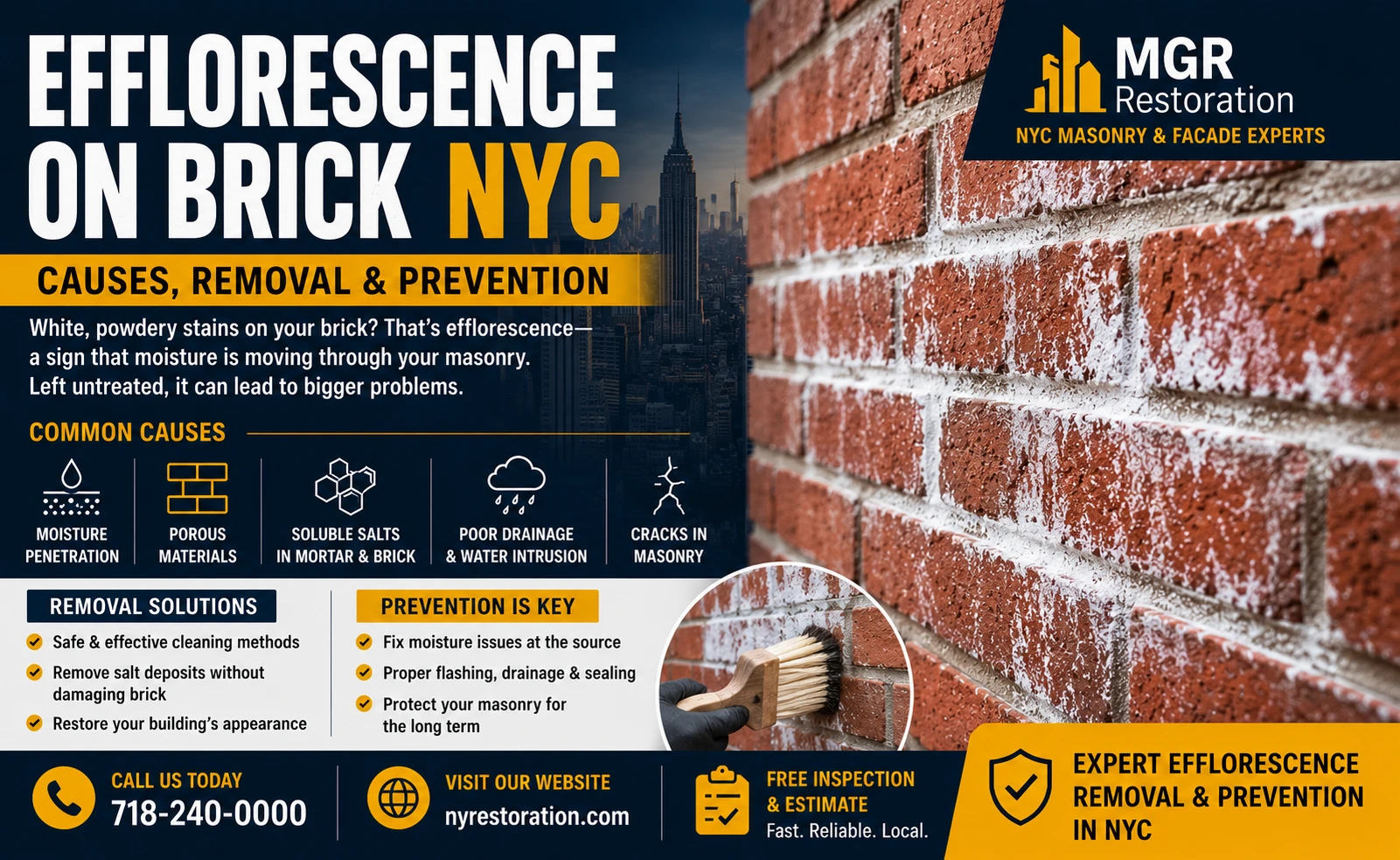
Efflorescence is not paint. It is not mold. It is not a coating that was applied to the wall. It is a natural chemical process — mineral salts that are present inside the masonry or mortar are dissolved by water moving through the wall, carried to the surface, and deposited there as the water evaporates.
The word comes from the French meaning “to flower out” — an apt description of the way these white salt crystals bloom across brick surfaces, often appearing seemingly overnight after rain or in the early spring as temperatures rise.
While efflorescence itself is not structurally dangerous, it is a reliable and important indicator that water is actively moving through your wall — and that deserves serious attention. MGR Restoration has assessed and repaired efflorescence-related water problems on hundreds of brick buildings across Manhattan, Brooklyn, Queens, the Bronx, and Staten Island. Here is everything you need to know.
Why Is Efflorescence So Common in NYC?
New York City has a perfect combination of conditions for efflorescence formation. Understanding why helps building owners take targeted preventive action.
NYC’s climate is relentless on masonry. The city experiences over 46 inches of rainfall per year — spread across all seasons — combined with high summer humidity and 40–60 freeze-thaw cycles every winter. This constant cycling of wet and dry, freeze and thaw, creates ideal conditions for water to move through masonry walls repeatedly, dissolving and redepositing mineral salts with each cycle.
NYC’s building stock is old. The vast majority of NYC’s brick buildings were constructed between 1870 and 1960. Original mortars, flashings, and waterproofing systems from this era have been aging for 60–150 years. As these systems deteriorate, water infiltration increases — and so does efflorescence.
Deferred maintenance compounds the problem. In a city where building maintenance is expensive and often deprioritized, small issues like hairline mortar cracks and failed window caulking go unaddressed for years. Each year of deferred maintenance means more water moving through the wall — and more efflorescence accumulating on the surface.
New construction and recent repairs can trigger it. Ironically, brand-new masonry and fresh repointing work can also produce efflorescence — the new mortar contains high concentrations of soluble salts that are flushed to the surface during the first several rain cycles. This type typically resolves on its own within one to two years.
What Causes Efflorescence on Brick?
Three conditions must exist simultaneously for efflorescence to form:
Condition 1 — Soluble Salts Must Be Present Soluble salts are found naturally in brick, mortar, concrete, stone, and the ground. The most common are calcium sulfate, sodium sulfate, potassium sulfate, and calcium carbonate. Portland cement-based mortars are particularly high in soluble salts — which is one reason improperly selected hard mortars used in repointing work often trigger new efflorescence on older buildings.
Condition 2 — Water Must Be Present to Dissolve the Salts Water is the transport mechanism. Without water moving through the masonry, salts stay where they are — dissolved water picks them up and carries them toward the surface.
Condition 3 — A Path Must Exist for the Water to Travel Water finds its way through cracks in mortar joints, failed caulking around windows, deteriorated flashings, cracked masonry units, and any other opening in the wall assembly. The path the water takes determines where efflorescence appears on the surface.
Remove any one of these three conditions and efflorescence cannot form. Effective treatment addresses all three — not just the visible white deposit on the surface.
Types of Efflorescence — Primary vs Secondary
Not all efflorescence is the same. Understanding which type you are dealing with determines the appropriate response.
Primary Efflorescence
Primary efflorescence appears on new masonry — fresh brickwork, newly repointed walls, or recently poured concrete — within the first few weeks or months after construction. It is caused by the high concentration of soluble salts in new mortar and concrete being flushed to the surface by rain during the curing period.
Primary efflorescence is generally considered a cosmetic issue. It typically diminishes significantly or disappears entirely within one to two years as the initial flush of salts is exhausted. Aggressive cleaning is generally not recommended — it often does more harm than good, and the problem resolves naturally.
Secondary Efflorescence
Secondary efflorescence appears on established masonry — buildings that have been standing for years or decades. This type is the serious one. It indicates that water is actively infiltrating the wall assembly through a specific deficiency — failed mortar joints, cracked masonry, deteriorated flashings, failed caulking, or a combination of these problems.
Secondary efflorescence does not resolve on its own. It will continue — and typically worsen — until the source of water infiltration is identified and repaired. Cleaning the surface removes the visible deposit but does nothing to address the underlying problem. The efflorescence will return — often within weeks — until the water pathway is closed.
The key question for any NYC building owner seeing efflorescence is: is this primary or secondary? If your building is more than two years old and efflorescence is appearing for the first time or increasing, it is almost certainly secondary — and a professional assessment is warranted.
Is Efflorescence Dangerous?
This is the question every building owner asks — and the answer requires an important distinction.
Efflorescence itself is not structurally dangerous. The mineral salt deposits on the brick surface are not toxic, they do not weaken the brick, and they do not directly cause structural failure. If the only problem were the white powder on the surface, it would be a cosmetic issue.
But what efflorescence tells you can be very serious.
Secondary efflorescence is a symptom — it is your building’s visible signal that water is actively moving through the wall. That water is causing damage that you cannot see:
- Water saturating masonry causes freeze-thaw spalling — physically breaking apart bricks and stone over repeated winter cycles
- Water reaching embedded steel lintels and shelf angles causes corrosion — corroding steel expands, cracking surrounding masonry and creating larger water entry points
- Water penetrating to the building interior causes damage to interior finishes, insulation, structural framing, and mechanical systems
- Persistent moisture inside wall cavities creates conditions for mold growth
- In buildings with underground vaults, water infiltration can compromise structural integrity
So while the white powder is harmless, ignoring what it represents can lead to repair bills many times larger than the cost of addressing the problem when it first appears.
⚠️ Important: If you see efflorescence accompanied by cracks in the masonry, rust staining, spalling brick faces, or interior water stains — do not wait. These are signs that the water infiltration causing the efflorescence is already causing structural damage. Contact MGR Restoration for an immediate assessment.
How to Remove Efflorescence from Brick
Efflorescence removal should always follow — never precede — repair of the underlying water source. Cleaning efflorescence off a wall that still has active water infiltration is a temporary fix; the deposits will return within weeks.
That said, once the underlying water problem has been addressed, here is how efflorescence is properly removed:
Method 1 — Dry Brushing (For Light, Recent Deposits)
For light efflorescence that has appeared recently on new or freshly repointed masonry, dry brushing with a stiff natural or nylon bristle brush is the first and gentlest approach. This removes loose surface deposits without introducing additional water — which can reactivate remaining salts.
Best for: Primary efflorescence on new masonry, light deposits on established masonry.
Tools needed: Stiff natural bristle brush, protective eyewear, dust mask.
Do not use: Wire brushes — they scratch the brick surface and embed metal particles that cause rust staining.
Method 2 — Water Washing (For Moderate Deposits)
For more established deposits, rinsing with clean water — either by hand or with a low-pressure garden hose — after dry brushing helps dissolve and flush remaining salts. Avoid high-pressure washing, which can drive water deeper into the wall and damage mortar joints.
Best for: Moderate efflorescence on sound masonry with no active water infiltration.
Important: Allow the wall to dry completely before assessing results. Efflorescence that appears to have been removed may reappear as the wall dries if salts remain in the substrate.
Method 3 — Dilute Acid Washing (For Heavy or Stubborn Deposits)
For heavy or crystallized efflorescence that dry brushing and water washing cannot remove, a dilute acid wash is the professional standard. White vinegar (acetic acid) at full strength is the mildest option suitable for DIY use. For more stubborn deposits, a dilute solution of muriatic acid (hydrochloric acid) at a ratio of 1 part acid to 10–12 parts water is effective — but must be handled with extreme care.
Professional acid washing process:
- Pre-wet the entire wall thoroughly — this prevents the acid from being absorbed too deeply into the brick
- Apply the dilute acid solution with a brush or sponge, working in small sections
- Allow to dwell for 3–5 minutes — no longer, as prolonged contact can damage brick and mortar
- Scrub gently with a natural bristle brush
- Rinse thoroughly with clean water — multiple times — to neutralize and remove all acid residue
- Allow to dry completely and assess
Safety requirements: Chemical-resistant gloves, protective eyewear, acid-resistant clothing, and adequate ventilation. Never use acid on limestone, marble, or other acid-sensitive stones — it will dissolve the surface. Test on an inconspicuous area first.
MGR Restoration strongly recommends professional application for acid washing on any building above one story. Improper acid washing causes permanent damage to brick and mortar, and working at height with hazardous chemicals requires proper safety equipment and training.
Method 4 — Proprietary Efflorescence Removers
Several commercial masonry cleaning products are formulated specifically for efflorescence removal — products such as Sure Klean 600 Detergent, Diedrich 202V, and similar professional-grade cleaners. These products are typically safer and more effective than DIY acid solutions and are the standard for professional masonry cleaning work.
MGR Restoration uses professional-grade cleaning products appropriate to each building’s specific masonry type and efflorescence severity as part of our masonry restoration and facade cleaning services.
What NOT to Do When Removing Efflorescence
Several common approaches cause more damage than the efflorescence itself:
- ❌ Do not use a wire brush. Wire brushes scratch brick surfaces and leave behind tiny metal particles that oxidize and cause rust staining — creating a new, worse problem.
- ❌ Do not use high-pressure power washing. High pressure drives water deep into the wall assembly, saturating masonry and mortar, and can physically erode mortar joints — creating new water infiltration pathways. It also drives salts deeper into the masonry rather than removing them.
- ❌ Do not apply acid to dry masonry. Acid applied to dry brick penetrates too deeply, attacks the brick body, and can cause permanent surface damage. Always pre-wet thoroughly.
- ❌ Do not use acid on limestone, brownstone, or marble. These materials are acid-sensitive — muriatic acid will dissolve them, causing irreversible surface damage. Use only pH-neutral or alkaline cleaners on these materials.
- ❌ Do not seal the wall before removing efflorescence. Applying a sealer over efflorescence traps the salts beneath the surface coating. As water continues to move through the wall, pressure builds behind the sealer, eventually causing it to bubble, crack, and delaminate — taking sections of the brick surface with it.
- ❌ Do not clean without repairing the source. Removing efflorescence without fixing the underlying water infiltration is like mopping the floor without fixing a leaking pipe. The deposits will return — typically within one to two rainstorms.
When Is Efflorescence a Sign of a Bigger Problem?
While all secondary efflorescence deserves attention, certain presentations are urgent warning signs that require immediate professional assessment:
Efflorescence accompanied by cracks in mortar joints or masonry units — the cracks are the water pathway. Active cracking combined with efflorescence means water infiltration is ongoing and likely worsening.
Efflorescence with rust staining — rust staining typically indicates corroding embedded steel — lintels, shelf angles, or wall ties. Corroding steel expands, cracking surrounding masonry and creating accelerating water infiltration. Our spandrel beam and lintel repair specialists regularly find that efflorescence with rust staining signals lintel corrosion that has been progressing for years.
Efflorescence with spalling brick — spalling combined with efflorescence indicates freeze-thaw damage is already occurring. The wall is absorbing water, freezing, and physically breaking apart. Prompt masonry restoration is required to prevent accelerating damage.
Efflorescence in new locations after previously not appearing — a sudden appearance of efflorescence on a building that previously showed none indicates a new water pathway has opened — a new crack, failed caulking, or flashing failure.
Efflorescence on interior walls — efflorescence that appears on interior masonry surfaces — basement walls, vault ceilings, interior brick — indicates water is moving through the wall from outside to inside. This is a more serious condition than exterior efflorescence and may indicate structural waterproofing failure.
Large quantities of efflorescence at parapet level — heavy efflorescence concentrated at or near the roofline typically indicates failed parapet coping, failed base flashings, or both — allowing large quantities of water to enter the top of the wall. Our facade repair team frequently finds that parapet-level efflorescence is the first visible sign of serious water damage to upper floors.
How to Prevent Efflorescence on NYC Brick Buildings
Prevention is always less expensive than treatment. Here is a practical maintenance program for NYC building owners:
Keep Mortar Joints in Good Condition
Deteriorated mortar joints are the primary water entry point in most NYC brick buildings. Having your masonry professionally repointed every 20–30 years — or sooner if deterioration is visible — is the single most effective step you can take to reduce water infiltration and the efflorescence it causes.
Maintain Window and Joint Caulking
Caulking at window perimeters, expansion joints, and material transitions has a lifespan of 10–20 years in NYC’s climate. Replacing failed caulking on a regular maintenance schedule prevents one of the most common and direct water infiltration pathways.
Inspect and Maintain Flashings
Flashings at window heads, sill transitions, parapet bases, and roof edges are critical water management components. Have them inspected every five years and replaced when signs of corrosion, detachment, or failure appear.
Apply a Breathable Water Repellent Treatment
A properly selected penetrating water repellent — one that is breathable, meaning it allows moisture vapor to escape from the wall while blocking liquid water entry — can significantly reduce water absorption in brick masonry. This is not a substitute for mortar repointing or crack repair, but it is an effective additional layer of protection.
Important: Use only breathable, penetrating repellents — never film-forming sealers or paint-like coatings that trap moisture inside the wall. Our facade restoration team can advise on the appropriate product for your building’s specific masonry type.
Address Roof and Parapet Issues Promptly
A significant proportion of the water that enters NYC brick buildings enters at the top — through failed parapet copings, deteriorated roof-to-wall flashings, or blocked roof drains. Keeping your roof and waterproofing systems in good repair is essential to keeping water out of the wall below.
Maintain Proper Drainage at Grade
Ensure that ground around your building grades away from the foundation, that sidewalks and yard areas drain properly, and that any underground vaults are waterproofed and drained. Our sidewalk and vault repair team regularly encounters efflorescence in basement and vault areas caused by poor drainage at grade level.
Efflorescence on Different Materials — Brick, Brownstone, Concrete & Stone
Efflorescence affects different masonry materials in different ways and requires tailored treatment approaches.
Efflorescence on Brick
The most common presentation in NYC. Treatment follows the methods described above — dry brushing, water washing, or carefully applied dilute acid for stubborn deposits. Always test on a small inconspicuous area first, as brick color and surface finish vary significantly.
Efflorescence on Brownstone
Brownstone (arkose sandstone) is acid-sensitive and softer than standard brick — making acid washing potentially damaging. Use pH-neutral masonry cleaners specifically formulated for sandstone. More importantly, brownstone’s high porosity means it is particularly vulnerable to the water infiltration that causes efflorescence — addressing the water source is even more urgent for brownstone buildings.
Our brownstone and stone repair specialists have extensive experience treating efflorescence on brownstone facades across Brooklyn and Manhattan, using cleaning methods that remove deposits without damaging this sensitive material.
Efflorescence on Limestone
Like brownstone, limestone is acid-sensitive. Use only alkaline or pH-neutral cleaners. Limestone is also susceptible to biological growth — moss and algae — that can appear alongside or be confused with efflorescence. Professional assessment is recommended before treatment.
Efflorescence on Concrete
Concrete surfaces — parking garage walls and decks, concrete block walls, precast panels — frequently develop efflorescence, particularly when new. The treatment approach is similar to brick, but the source of water infiltration in concrete structures often involves concrete cracks, failed expansion joints, or waterproofing membrane failure rather than mortar joint deterioration. Our parking garage repair team addresses efflorescence on concrete structures as part of comprehensive repair scopes.
Efflorescence on Terracotta
Efflorescence on terracotta — the decorative fired clay used extensively on pre-war NYC buildings — is a particularly important warning sign. Because terracotta units are hollow, water that has entered through cracks or failed mortar joints accumulates inside the unit and can cause internal freeze-thaw damage, anchor corrosion, and ultimately unit failure. Our terracotta repair specialists assess efflorescence on terracotta facades as part of a comprehensive condition survey.
Local Law 11 & Efflorescence in NYC
For NYC buildings six stories and taller, efflorescence on the facade is directly relevant to Local Law 11 (FISP) compliance. During a Facade Inspection Safety Program inspection, a Qualified Exterior Wall Inspector (QEWI) assesses all visible facade conditions — including efflorescence — as indicators of water infiltration and potential underlying deterioration.
Significant or widespread efflorescence on a facade frequently triggers a SWARMP rating — requiring documented repairs within the next inspection cycle. Efflorescence accompanied by cracking, spalling, or displaced masonry can contribute to an Unsafe rating — requiring immediate action and mandatory sidewalk shed installation.
Building owners who address the water infiltration causing efflorescence before their FISP filing deadline avoid the pressure and expense of emergency compliance repairs. Our team works alongside QEWI inspectors to identify and repair all water infiltration sources — helping buildings achieve and maintain Safe ratings.
👉 Learn more about Local Law 11 & FISP Facade Inspections
👉 Read: SWARMP vs Unsafe NYC Facade Ratings Explained
Efflorescence Repair Costs in NYC
The cost of addressing efflorescence depends almost entirely on what is causing it — the cleaning itself is a small part of the total scope.
| Scope of Work | Estimated Cost Range |
|---|---|
| Professional efflorescence cleaning only (per sq ft) | $3 – $8 per sq ft |
| Mortar repointing — targeted (per sq ft) | $10 – $25 per sq ft |
| Full facade repointing — brownstone | $15,000 – $50,000 |
| Window caulking replacement (per window) | $150 – $500 per window |
| Flashing replacement (per linear ft) | $50 – $200 per linear ft |
| Lintel replacement (per lintel) | $1,500 – $6,000 per lintel |
| Parapet repair & waterproofing (per linear ft) | $300 – $800 per linear ft |
| Breathable water repellent treatment (per sq ft) | $2 – $6 per sq ft |
All figures are general estimates. The actual scope and cost for your building depend on a professional site assessment. MGR Restoration provides free, no-obligation written estimates.
👉 Schedule a free efflorescence assessment
Related Services for NYC Building Owners
FAQs
Get a Free Efflorescence Assessment — All NYC Boroughs
White stains on your brick wall are your building telling you something important. MGR Restoration diagnoses the source, repairs the water infiltration, and restores your facade — across all five boroughs of New York City.
📞 Call now: 718-240-0000
🌐 Schedule a free assessment
🔧 View all services
📍 Serving Manhattan · Brooklyn · Queens · The Bronx · Staten Island
📍 48-11 69th Street, Woodside NY 11377 | contact@nyrestoration.com