Exterior wall repair is the process of diagnosing, restoring, and protecting the outer walls of a building — the first line of defense against New York City’s harsh climate, heavy rainfall, freezing winters, and relentless urban environment.
For NYC building owners and property managers, exterior wall repair is not optional maintenance — it is a legal and financial necessity. Deteriorating exterior walls allow water to penetrate into the building’s structure, causing progressive damage to interior finishes, structural elements, and mechanical systems. Left unaddressed, what begins as a hairline crack in the mortar can escalate into major structural repairs costing tens or hundreds of thousands of dollars.
MGR Restoration provides comprehensive exterior wall repair services for residential, commercial, and mixed-use buildings across all five boroughs of New York City — from single-family brownstones in Brooklyn to high-rise apartment towers in Manhattan.
2. Types of Exterior Walls in NYC Buildings
New York City’s building stock spans over two centuries of construction, and its exterior walls reflect a wide range of materials, methods, and eras. Understanding what your wall is made of is the first step in diagnosing problems and planning repairs.
Brick Masonry Walls
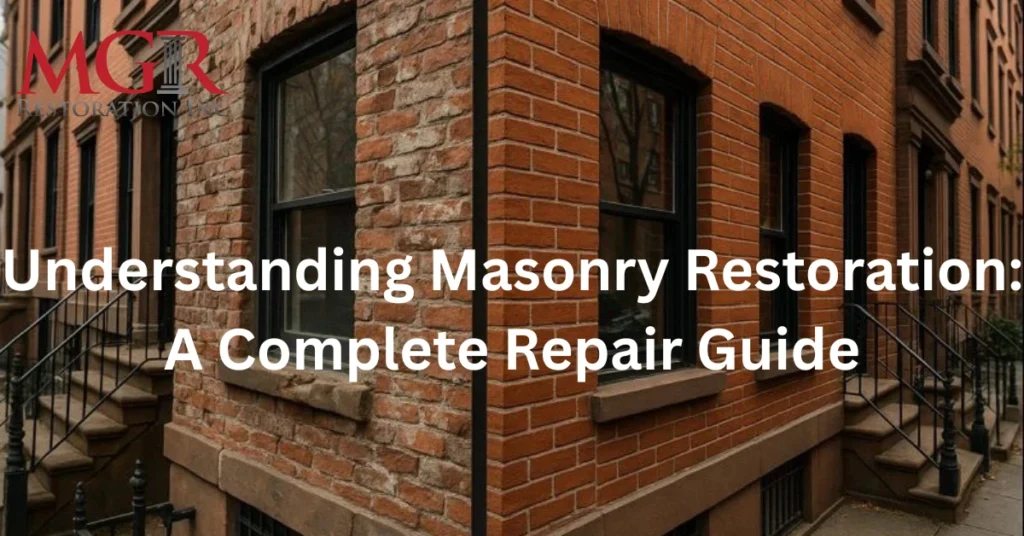
By far the most common exterior wall type in NYC. Brick masonry walls consist of clay brick units set in mortar — either as a solid wall (common in older buildings) or as a cavity wall with a brick outer wythe and a concrete masonry or steel stud backup.
Brick walls are durable but require periodic maintenance — particularly repointing of mortar joints and repair of cracked or damaged brick units.
Brownstone & Stone Facade Walls
Thousands of NYC rowhouses and townhouses are clad in brownstone (arkose sandstone), limestone, granite, or other natural stones. These walls have their own specific deterioration patterns and repair requirements.
Read our full guide: Stone Repair in NYC — Brownstone, Limestone & Granite
Terracotta Clad Walls
Pre-war commercial and residential buildings from the 1880s–1930s are frequently clad in decorative terracotta panels and ornament. Terracotta walls have unique repair requirements due to the hollow nature of the units and the role of steel anchors in holding them to the building.
Read our full guide: Terracotta Repair in NYC
Concrete Walls
Mid-century and modern buildings often feature poured concrete or precast concrete panel exterior walls. Concrete walls develop cracks, spalling, and carbonation-related deterioration over time.
Stucco & EIFS Walls
Some NYC buildings are clad in stucco (a cementitious plaster applied over masonry or metal lath) or EIFS (Exterior Insulation and Finish System — a synthetic stucco system). Both require specialist repair to prevent water infiltration behind the cladding.
Mixed Material Walls
Many NYC buildings combine multiple wall materials — a brick base with limestone upper floors, a terracotta cornice over a brick facade, or a concrete frame with brick infill panels. Mixed material walls require assessment of each component’s condition and compatibility of repair materials.
3. Why Do Exterior Walls Deteriorate in NYC?
New York City’s environment is particularly challenging for building exteriors. The combination of climate, urban pollution, and the age of the building stock means that deterioration is inevitable — the only question is how quickly it progresses and whether it is addressed before it becomes a serious problem.
Freeze-Thaw Cycling
NYC typically experiences 40–60 freeze-thaw cycles per winter. Water that has infiltrated cracks, mortar joints, or porous masonry freezes, expands by approximately 9%, and physically fractures the surrounding material. Each cycle causes additional damage — accelerating deterioration year over year.
Water Infiltration
Water is the root cause of the vast majority of exterior wall problems. It enters through cracks, failed mortar joints, deteriorated caulking, failed window perimeters, and damaged or missing flashings. Once inside the wall assembly, water causes masonry deterioration, steel corrosion, wood rot, and mold growth.
NYC Weather Extremes
New York City experiences the full range of North American weather extremes — hot, humid summers, freezing winters, heavy rainfall, and periodic nor’easters. This wide temperature and moisture range stresses building materials more than moderate climates.
Air Pollution & Acid Rain
NYC’s urban atmosphere contains elevated levels of sulfur dioxide and nitrogen oxides that form weak acids when combined with rainwater. These acids chemically attack limestone, marble, and mortar — gradually dissolving the material and weakening the wall surface.
Age of Building Stock
Much of NYC’s building stock is 50–150 years old. Original materials, mortars, and waterproofing systems were not designed to last indefinitely without maintenance. As buildings age, the accumulated effect of decades of weather cycling and deferred maintenance accelerates deterioration.
Structural Movement
Buildings settle over time. Differential settlement — where one part of a building settles more than another — causes cracking in exterior walls. Thermal movement, vibration from street traffic, and nearby construction can all contribute to structural cracking.
Improper Previous Repairs
One of the most common causes of accelerated wall deterioration we encounter is improper past repairs — particularly the use of hard Portland cement mortars to repoint soft brick or stone walls. Hard cement traps moisture, concentrates stress, and causes the surrounding masonry to crack and spall.
4. Common Exterior Wall Problems in NYC
Mortar Joint Deterioration
The mortar joints between brick, stone, or masonry units are the most vulnerable element of any masonry wall. Mortar deteriorates faster than the masonry units themselves — typically requiring repointing every 25–50 years depending on exposure and mortar type. Deteriorated joints allow water infiltration that damages the entire wall assembly.
Cracked Masonry
Cracks in brick, stone, or concrete walls range from minor cosmetic cracks to serious structural failures. The pattern, width, and location of cracks provide important clues about their cause — thermal movement, structural settlement, water damage, or overload.
Spalling Brick & Stone
Spalling occurs when the face of a brick or stone unit breaks away — typically due to freeze-thaw damage to water-saturated masonry. Spalled units are both unsightly and structurally weakened.
Efflorescence
The white crystalline deposits often seen on brick and masonry walls are called efflorescence — mineral salts carried to the surface by water migrating through the wall. Efflorescence is a symptom of water infiltration and should be investigated rather than simply cleaned off.
Bulging & Bowing Walls
When the ties connecting a brick facade wythe to the backup wall corrode and fail, the outer brick skin can separate and bow outward. This is a serious structural condition and a falling hazard requiring immediate attention.
Failed Caulking & Sealants
Caulking at window perimeters, expansion joints, and transitions between different wall materials deteriorates over time — typically lasting 10–20 years before requiring replacement. Failed caulking is a primary water infiltration point.
Lintel & Shelf Angle Corrosion
Steel lintels above window and door openings, and steel shelf angles that support the outer brick wythe at each floor level, are embedded in the wall assembly and subject to corrosion. Corroding steel expands, cracking the surrounding masonry. This is a very common problem in NYC buildings of all ages.
Parapet Wall Deterioration
Parapet walls — the low walls extending above the roofline — are among the most exposed elements of any building facade. They are subject to water from above (the roof) and from both sides, making them particularly vulnerable to deterioration. Failed parapet flashings and coping stones are a primary source of water infiltration into the wall below.
⚠️ Safety Warning: Bulging, cracked, or deteriorated parapet walls are a serious falling hazard. NYC Local Law 11 specifically addresses parapet conditions. If you see bulging or significant cracking in your parapet wall, contact MGR Restoration immediately.
5. When to Repair vs. Replace Your Exterior Wall
One of the most important — and most misunderstood — decisions in exterior wall maintenance is knowing when repair is appropriate and when replacement is necessary.
| Wall Condition | Recommended Approach |
|---|---|
| Deteriorated mortar joints, masonry intact | Repointing — repair |
| Isolated cracked or spalled brick / stone units | Spot replacement of damaged units — repair |
| Widespread brick spalling across facade | Full facade restoration — likely partial replacement |
| Hairline cracks, no active movement | Monitor, seal — repair |
| Active structural cracks with movement | Engineering assessment, then repair or rebuild |
| Bulging facade wythe, failed ties | Emergency stabilization, then rebuild — replacement |
| Isolated failed caulking at joints | Recaulking — repair |
| Widespread failed caulking, water damage | Full caulking replacement + wall repairs |
| Deteriorated parapet, coping failed | Parapet rebuild — partial replacement |
| Single failed lintel | Lintel replacement — targeted repair |
| Multiple failed lintels, widespread corrosion | Systematic lintel replacement program |
Our philosophy is always repair-first. Original masonry materials carry historical value and are often irreplaceable. We only recommend replacement when repair is no longer structurally or economically viable.
6. Types of Exterior Wall Repairs MGR Restoration Performs
Brick Repointing (Tuckpointing)
We rake out deteriorated mortar to a minimum depth of ¾ inch and repoint with a fresh mortar matched to the original in color, texture, and — most importantly — hardness and flexibility. Using the wrong mortar is one of the most common and damaging mistakes in masonry repair.
Learn more about our Masonry Restoration & Brick Pointing services
Brick Replacement
Where individual bricks are cracked, spalled, or missing, we carefully remove the damaged unit and install a replacement brick matched as closely as possible to the original in color, size, and texture.
Crack Repair & Injection
Structural and non-structural wall cracks are cleaned, evaluated, and repaired using epoxy injection (for structural cracks requiring bonding) or polyurethane injection (for cracks requiring flexible, waterproof sealing).
Lintel & Shelf Angle Replacement
We remove deteriorated lintels and shelf angles — carefully shoring the masonry above — and install new galvanized or stainless steel lintels designed to last for decades without corrosion.
Wall Tie Installation
Where facade wythes have separated from the backup wall due to failed ties, we install new stainless steel helical wall ties drilled through the outer wythe and anchored into the backup structure — restoring the connection without requiring wall demolition.
Parapet Repair & Rebuilding
We repair and rebuild deteriorated parapet walls — including rebuilding brick, replacing coping stones, installing new lead or metal flashings, and restoring the parapet cap to a watertight condition.
Caulking & Sealant Replacement
We remove all deteriorated caulking at window perimeters, expansion joints, and material transitions, and install new high-performance sealants appropriate for each joint type and movement requirement.
Stucco & EIFS Repair
We repair cracks, delaminated areas, and failed sections of stucco and EIFS wall systems — matching the original texture and finish as closely as possible.
Concrete Wall Repair
For concrete walls, we repair spalling, cracks, and carbonation damage using engineered concrete repair systems — including surface preparation, corrosion treatment of exposed rebar, and application of repair mortars meeting structural performance requirements.
Stone Facade Repair
For brownstone, limestone, granite, and other stone-clad walls, we provide specialist stone repair services.
Read our full guide: Stone Repair in NYC
Terracotta Wall Repair
For pre-war buildings with terracotta-clad walls, we provide specialist terracotta assessment, repair, and restoration.
Read our full guide: Terracotta Repair in NYC
7. Exterior Wall Waterproofing in NYC
Repairing visible damage is only half the job. Without addressing water infiltration at its source, repaired walls will deteriorate again. MGR Restoration provides comprehensive wall waterproofing services as part of every exterior repair project.
Clear Water Repellent Treatments
For brick and masonry walls in sound condition, penetrating clear water repellents dramatically reduce water absorption without changing the appearance of the wall. These breathable treatments allow moisture vapor to escape from the wall while preventing liquid water from entering.
Elastomeric Coatings
For walls with widespread fine cracking, elastomeric waterproof coatings can bridge hairline cracks and provide a continuous waterproof membrane over the entire wall surface. These coatings require careful selection — the wrong product can trap moisture and cause serious damage.
Flashing & Coping Restoration
Roof-to-wall flashings, window head flashings, and coping stones at parapets are critical water management elements. Failed flashings are a primary source of wall water infiltration. We restore and replace flashings as part of comprehensive wall repair projects.
Expansion Joint Installation
Where walls lack adequate expansion joints, thermal and structural movement concentrates stress and causes cracking. We install properly designed expansion joints that accommodate movement while maintaining a watertight wall assembly.
Learn more about our Roofing & Waterproofing services
8. NYC Local Law 11 & Exterior Wall Compliance
For buildings six stories or taller, exterior wall repair in NYC is directly tied to compliance with Local Law 11 — the Facade Inspection Safety Program (FISP).
What Does FISP Require?
FISP requires periodic inspection of all exterior walls and appurtenances (cornices, parapets, fire escapes, balconies, and so on) by a Qualified Exterior Wall Inspector (QEWI) — typically a licensed structural engineer or registered architect.
After inspection, facades receive one of three ratings:
- Safe — No immediate action required
- SWARMP — Repairs required within the next inspection cycle (approximately 5 years)
- Unsafe — Immediate repairs required; sidewalk shed must be installed until repairs are certified complete
What Triggers an Unsafe Rating?
Common wall conditions that result in an Unsafe FISP rating include:
- Bulging or displaced masonry
- Cracked or loose terracotta
- Deteriorated parapet walls
- Loose or missing coping stones
- Corroded lintels causing masonry cracking
- Detached balcony or cornice elements
MGR Restoration works directly with FISP inspectors and building engineers to execute the repairs required to resolve Unsafe ratings and bring buildings into compliance within DOB timelines.
Learn more about Local Law 11 & FISP Facade Inspections
9. Exterior Wall Repair for NYC Landmark Buildings
Many of NYC’s older buildings — particularly those with brick, brownstone, limestone, or terracotta exterior walls — are Individual Landmarks or are located within Historic Districts regulated by the NYC Landmarks Preservation Commission (LPC).
For landmarked buildings, all exterior repair work requires LPC approval before work begins. This includes:
- Mortar repointing (mortar composition and color must be approved)
- Brick or stone replacement (materials must match the original)
- Caulking replacement (product and color subject to review)
- Any change to the wall surface appearance
MGR Restoration is experienced in working within LPC guidelines. We prepare the required documentation, recommend historically appropriate repair materials, and guide clients through the LPC approval process — while also managing any parallel FISP compliance requirements.
10. Our Exterior Wall Repair Process Step by Step
Step 1: Site Assessment & Condition Survey
We conduct a thorough visual and hands-on inspection of the exterior wall — assessing crack patterns, mortar joint condition, masonry unit integrity, caulking condition, water staining, efflorescence, and any evidence of structural movement or water infiltration.
Step 2: Written Report & Estimate
We provide a detailed written scope of work documenting all identified conditions and our recommended repair approach for each, together with a transparent cost estimate.
Step 3: Engineering Consultation (if required)
For structural concerns — bulging walls, active cracking, lintel failure — we coordinate with a licensed structural engineer to ensure repairs address the root cause and meet structural requirements.
Step 4: Permitting & LPC Filing
We handle all required DOB permits and, for landmarked buildings, prepare and submit LPC filings.
Step 5: Access Setup
We install scaffolding, suspended scaffolds, or aerial lifts as required to safely access all areas of the wall requiring repair.
Learn more about our Suspended Scaffold services
Step 6: Repair Execution
Our skilled masonry craftsmen execute each repair per the approved scope — repointing, crack injection, brick replacement, lintel replacement, caulking, waterproofing, and any other required work.
Step 7: Quality Inspection
We conduct a thorough inspection of completed work before scaffold removal — ensuring every repair meets our quality standards.
Step 8: Final Documentation & DOB/LPC Filing
For FISP-related repairs, a licensed engineer certifies the completed work and files the required documentation with the NYC Department of Buildings.
11. Exterior Wall Repair Costs in NYC
Wall repair costs vary based on wall type, extent of damage, building height, access requirements, and permit/LPC requirements.
| Repair Type | Estimated Cost Range |
|---|---|
| Brick repointing (per sq ft) | $10 – $25 per sq ft |
| Spot brick replacement (per brick) | $50 – $150 per brick |
| Crack injection & sealing (per linear ft) | $20 – $60 per linear ft |
| Lintel replacement (per lintel) | $1,500 – $6,000 per lintel |
| Wall tie installation (per tie) | $50 – $150 per tie |
| Parapet rebuilding (per linear ft) | $300 – $800 per linear ft |
| Caulking replacement (per linear ft) | $8 – $25 per linear ft |
| Clear water repellent (per sq ft) | $2 – $6 per sq ft |
| Full facade restoration | $50,000 – $1,000,000+ |
All estimates are general ranges. Contact MGR Restoration for a free site assessment and detailed written quote.
Request a free wall repair estimate
12. Related Services for NYC Building Owners
Exterior wall repair is the foundation of building maintenance — and often connects with a range of complementary services:
FAQs About Exterior Wall Repair in NYC
Get a Free Exterior Wall Repair Estimate in NYC
Don’t wait for a small crack to become a major problem — or for a FISP inspector to issue an Unsafe rating. MGR Restoration provides expert exterior wall assessment, repair, and restoration services for buildings throughout New York City.
📞 Call us: 718-240-0000
🌐 Contact MGR Restoration
🔧 View All Services
📍 48-11 69th Street, Woodside NY 11377 | contact@nyrestoration.com