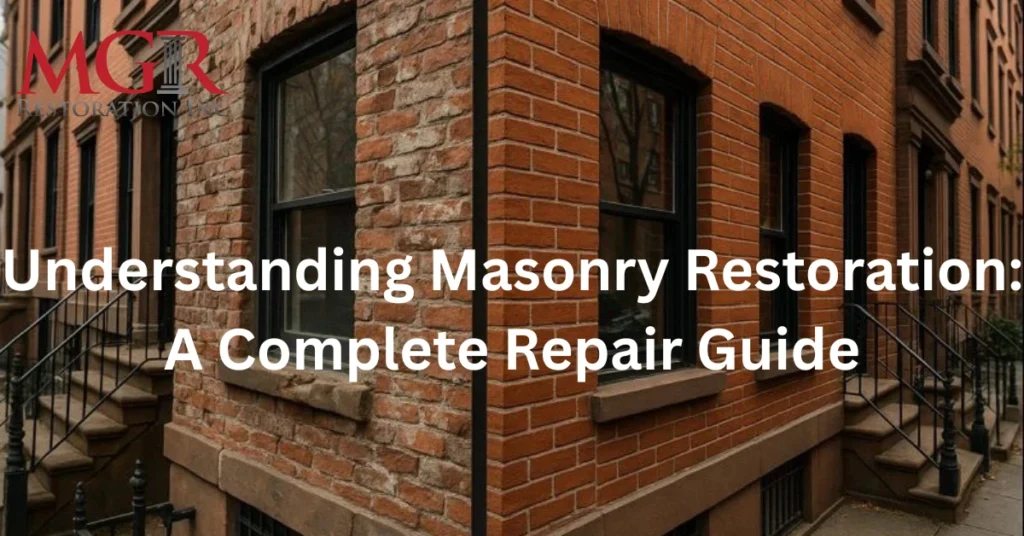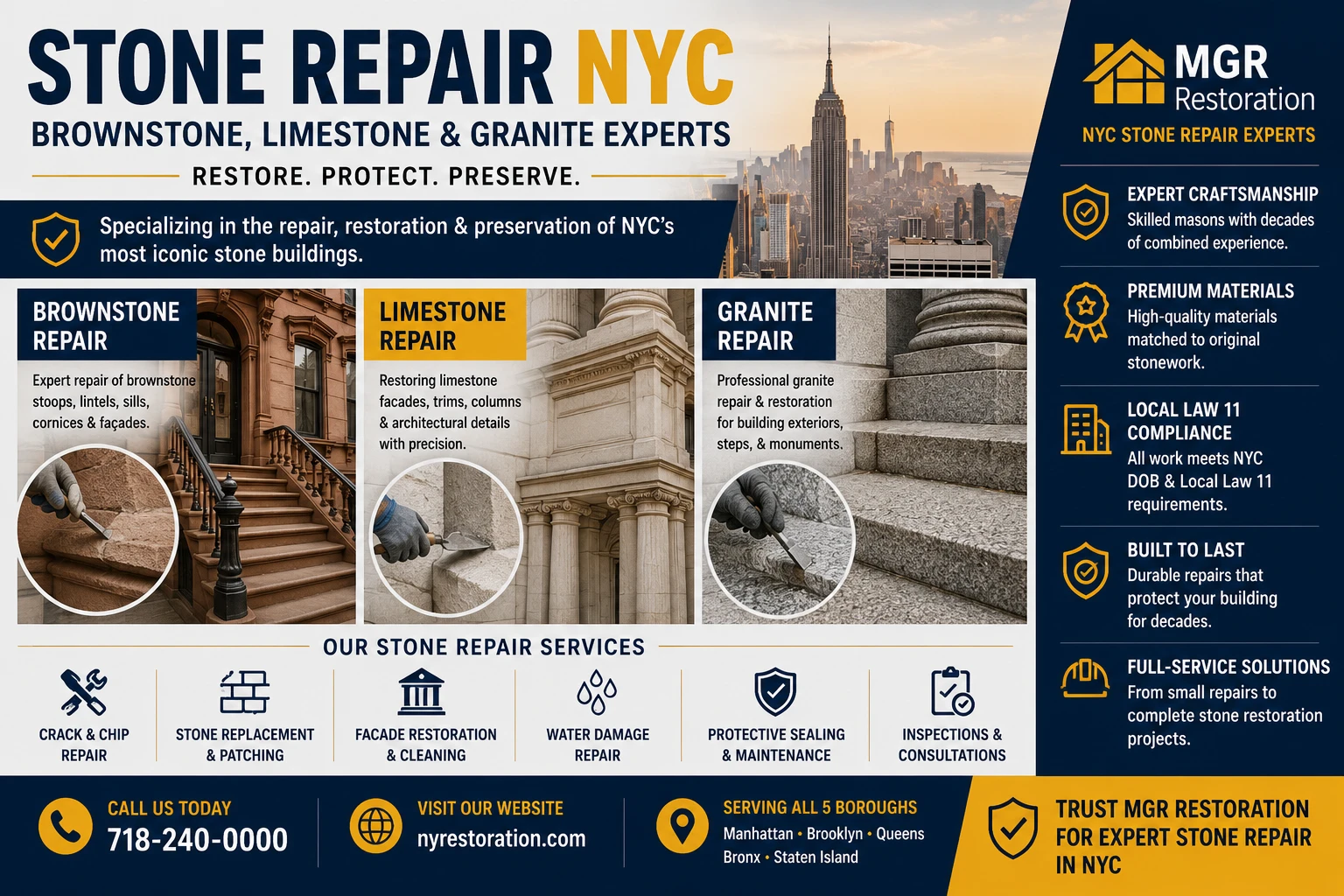
Stone repair is the process of restoring deteriorated, cracked, spalled, or damaged natural stone on building facades, stoops, steps, cornices, lintels, sills, and other architectural elements. In New York City, stone repair is a critical maintenance service for the thousands of brownstones, limestone-clad buildings, granite structures, and landmarked properties across the five boroughs.
Unlike brick or concrete, natural stone is irreplaceable in its original form. Each stone block was quarried, cut, and installed — sometimes over a century ago. When it deteriorates, the goal is always to repair and preserve first, replace only when absolutely necessary.
MGR Restoration specializes in matching original stone materials, textures, and colors to ensure repairs are seamless and historically accurate.
2. Types of Stone Found on NYC Buildings
New York City’s architectural history is written in stone — literally. Different eras of construction favored different stone types, and each has its own characteristics, vulnerabilities, and repair requirements.
Brownstone (Arkose Sandstone)
The most iconic stone in New York City. Brownstone is a reddish-brown sandstone quarried primarily from the Connecticut River Valley and Portland, Connecticut. It was the dominant building material for rowhouses and townhouses in Brooklyn, Manhattan, and the Bronx from roughly 1840 to 1900.
Brownstone is a relatively soft and porous stone, which makes it highly vulnerable to water infiltration, freeze-thaw damage, and surface spalling.
Limestone
Limestone became popular in NYC construction from the late 19th century through the mid-20th century. It is harder and more durable than brownstone but still susceptible to acid rain, water infiltration, and biological growth (moss, algae, black crust).
Limestone is found on many of NYC’s most prominent buildings — from grand apartment houses on the Upper West Side to commercial buildings in Midtown Manhattan.
Granite
Granite is the most durable of the common building stones. It is dense, hard, and highly resistant to weathering. Granite is found primarily on building bases, stoops, steps, curbs, and institutional buildings. While more durable, granite is not immune to cracking, spalling, and joint failure over time.
Bluestone
A dark gray sandstone quarried in the Hudson Valley, bluestone is the traditional material for NYC sidewalks, stoops, and steps. It is durable but can crack, chip, and spall — especially on heavily trafficked stoops and entry stairs.
Sandstone & Other Stones
Beyond brownstone and bluestone, other sandstones, marbles, and regional stones appear on older NYC buildings. Each requires careful assessment to determine the appropriate repair approach.
3. Why Does Stone Deteriorate in NYC?
New York City’s climate and urban environment are particularly harsh on natural stone. Understanding the causes of deterioration helps property owners take proactive steps to protect their buildings.
Freeze-Thaw Cycles
NYC experiences dozens of freeze-thaw cycles every winter. Water infiltrates porous stone, freezes, expands by approximately 9%, and physically fractures the stone from within. Over years and decades, this causes progressive spalling, cracking, and surface loss.
Acid Rain & Air Pollution
NYC’s urban atmosphere contains sulfur dioxide and nitrogen oxides from vehicle emissions and industrial sources. These combine with rainwater to form weak acids that chemically dissolve limestone and marble — a process called acid dissolution. Black sulfate crust, a dark sooty deposit, is a common symptom on limestone buildings throughout the city.
Water Infiltration
Water is the single greatest enemy of stone buildings. When mortar joints fail, when coping stones crack, or when waterproofing deteriorates, water penetrates the wall assembly and accelerates deterioration of both the stone and the underlying structure.
Biological Growth
Moss, algae, lichens, and other biological organisms colonize stone surfaces — especially on north-facing or shaded walls. Biological growth holds moisture against the stone surface and accelerates chemical deterioration.
Deferred Maintenance
Many NYC buildings have not had proper stone maintenance in decades. Small cracks become large fractures. Failed mortar joints allow water infiltration. What could have been a minor repair becomes a major restoration project.
Improper Past Repairs
Ironically, some of the worst damage we see is caused by improper previous repairs — particularly the use of Portland cement mortars that are too hard for soft stones like brownstone. Hard cement traps moisture inside the stone and causes it to spall and crack around the repair.
4. Common Stone Damage Problems in NYC Buildings
Spalling
Spalling is when the surface layer of stone peels, flakes, or pops off — exposing the raw stone beneath. It is extremely common in brownstone and is almost always caused by water infiltration and freeze-thaw cycling.
Cracking
Cracks in stone can be hairline (surface only) or through-cracks (structural). Cracks allow water infiltration, which accelerates further deterioration. Through-cracks in load-bearing lintels or sills are a serious structural concern.
Erosion & Surface Loss
Soft stones like brownstone and sandstone gradually erode over time — especially on exposed horizontal surfaces like sills, cornices, and steps where water sits and concentrates.
Failed Mortar Joints
The mortar between stone blocks deteriorates faster than the stone itself. Failed joints allow water to enter the wall cavity, causing damage to both the stone and the underlying brick backup wall.
Staining
Oil stains, rust stains, graffiti, biological staining, and black sulfate crust are all common on NYC stone buildings. Different stains require different cleaning approaches — the wrong treatment can damage the stone permanently.
Delamination
In some stones, particularly brownstone, the bedding planes of the stone can separate — causing large slabs of the face to detach. This is an advanced form of deterioration that requires prompt repair.
⚠️ Warning: If you see large sections of stone face separating or bulging outward on your building, this is a potential falling hazard. Contact MGR Restoration immediately for an emergency assessment.
5. Brownstone Repair in NYC
Brownstone repair is one of our most requested services. Brooklyn alone has tens of thousands of brownstone rowhouses, and virtually all of them need some degree of stone repair.
The Challenge of Brownstone
Brownstone is notoriously difficult to repair correctly because:
- It is soft and porous, absorbing water readily
- It has a directional grain (bedding planes) that affects how it weathers and how repairs must be made
- Color and texture matching is difficult — brownstone varies significantly in color from building to building
- Many past repairs used inappropriate Portland cement that has caused additional damage
How We Repair Brownstone
Surface Consolidation: For early-stage spalling, we apply consolidants that penetrate the stone and re-bond weakening surface layers — extending the life of the original stone without removing material.
Cementitious Patching: For areas with active spalling and material loss, we apply custom-blended repair mortars matched to the color, texture, and hardness of the original stone. We never use standard Portland cement, which is too hard and causes further damage.
Cast Stone Replacement: Where stone loss is too extensive for patching, we fabricate cast stone replacement pieces that match the original profile, color, and texture of the missing section.
Full Stone Block Replacement: In severe cases, we source and install natural brownstone replacement blocks — cut to match the original dimensions and profile.
Mortar Joint Repointing: We rake out deteriorated mortar joints and repoint with a lime-based mortar matched to the original — never hard cement.
Water Repellent Treatment: After repairs, we apply a breathable water repellent to protect the stone from future water infiltration while allowing moisture vapor to escape.
Learn more about our Brownstone, Limestone & Granite Repair services.
6. Limestone Repair in NYC
Limestone repair requires a different approach than brownstone due to its different composition, density, and weathering characteristics.
Common Limestone Problems
- Black sulfate crust (sooty black deposits from acid rain reaction)
- Surface erosion and loss of carved detail
- Cracking from structural movement or thermal cycling
- Biological growth (green algae, black fungi)
- Failed mortar joints
How We Repair Limestone
Chemical Cleaning: We use pH-appropriate cleaning systems to remove black crust, biological growth, and staining without damaging the stone surface. We never use pressure washing on limestone, which erodes the surface.
Consolidation: Weakened or friable limestone surfaces are treated with consolidants to re-bond the stone structure before any repair work.
Lime Mortar Patching: Damaged areas are repaired with custom-blended lime putty mortars matched to the color and texture of the original stone.
Carved Detail Restoration: Lost or eroded carved details — moldings, cornices, decorative elements — can be restored using castings made from surviving original details on the same building.
Joint Repointing: Deteriorated mortar joints are repointed with appropriate lime-based mortars compatible with the limestone.
7. Granite Repair in NYC
While granite is the most durable of the common building stones, it is not indestructible. NYC’s granite stoops, steps, base courses, and institutional facades develop their own set of problems over time.
Common Granite Problems
- Cracking from structural settlement or impact
- Spalling on exposed horizontal surfaces (steps, treads)
- Joint failure between granite blocks
- Surface staining (oil, rust, graffiti)
- Biological growth in shaded locations
How We Repair Granite
Crack Repair: Structural cracks in granite are cleaned, injected with epoxy or polyurethane, and patched with color-matched granite dust compounds.
Step & Tread Repair: Chipped, cracked, or worn granite steps can often be repaired in place using epoxy-based granite repair systems matched to the original color.
Joint Repointing: We repoint deteriorated joints between granite blocks with appropriate mortars — typically stiffer than limestone or brownstone mortars due to granite’s low absorption.
Cleaning & Sealing: Granite responds well to professional cleaning followed by a penetrating sealer that repels water and staining while preserving the natural appearance of the stone.
8. Bluestone & Sandstone Repair in NYC
Bluestone is the classic NYC stoop and step material — and one of the most commonly repaired stones we work with.
Common Bluestone Problems
- Cracking and splitting (bluestone has natural cleavage planes)
- Surface spalling and delamination
- Chipped nosings on stair treads — a serious trip hazard
- Staining from iron pyrite (natural rust staining within the stone)
How We Repair Bluestone
Crack Repair: Small cracks are cleaned and filled with color-matched epoxy compounds. Large cracks or split slabs typically require replacement.
Nosing Repair: Chipped or broken stair nosings are rebuilt using epoxy-based systems matched to the bluestone color — restoring both appearance and safety.
Full Slab Replacement: When bluestone is too damaged to repair, we source and install new bluestone slabs matched to the size, color, and finish of the original.
Anti-Slip Treatment: For stoop and stair repairs, we can apply anti-slip treatments to reduce the risk of falls on wet or icy surfaces.
Related: Sidewalk Repair & Vault Repair in NYC — we also repair bluestone and concrete sidewalks.
9. Stone Repair vs Stone Replacement — Which Do You Need?
One of the most common questions we get is: can this be repaired, or does it need to be replaced?
The answer depends on several factors:
| Condition | Repair or Replace? |
|---|---|
| Surface spalling, less than 1 inch deep | Repair |
| Hairline cracks, no structural movement | Repair |
| Active cracking with ongoing movement | Investigate cause, then repair or replace |
| Through-cracks in structural lintels/sills | Often replace |
| Delaminating face stone, large sections | Replace |
| Eroded surface, detail lost but stone intact | Repair / cast stone patch |
| Stone completely fractured or missing | Replace |
| Isolated damaged block in otherwise sound wall | Replace single block |
Our approach is always repair-first. Original stone is irreplaceable and carries historical and aesthetic value. We only recommend full replacement when repair is no longer structurally or aesthetically viable.
10. Stone Repair for NYC Landmark Buildings
Many of NYC’s most important stone buildings are located within Historic Districts or are Individual Landmarks designated by the NYC Landmarks Preservation Commission (LPC). If your building is landmarked, all exterior repair work — including stone repair — requires LPC approval before work begins.
What This Means for You
- Repair methods and materials must be approved by the LPC
- In most cases, the LPC requires like-for-like repairs using materials that match the original as closely as possible
- Hard cement patches are almost never approved for landmarked stone buildings
- Proper documentation and filing is required
MGR Restoration has experience working within LPC guidelines. We prepare the necessary documentation, recommend appropriate repair methods, and can help guide you through the approval process.
💡 Pro Tip: LPC approval can take time. If your building is landmarked and you have stone damage, start the process early — especially if you are also dealing with a Local Law 11 (FISP) compliance deadline.
Learn more about Local Law 11 Facade Compliance & FISP Inspections.
11. Our Stone Repair Process Step by Step
Here is what to expect when you hire MGR Restoration for a stone repair project:
Step 1: Initial Assessment & Estimate
We visit your property, assess the condition of the stone, identify the causes of deterioration, and provide a detailed written estimate. This assessment is free of charge.
Step 2: Material Testing & Matching
For significant projects, we test the original stone to determine its composition, hardness, and color — then source or blend repair materials that match as closely as possible.
Step 3: Permitting (if required)
For work on buildings requiring DOB permits or LPC approval, we handle the filing process on your behalf.
Step 4: Scaffold or Lift Setup
Depending on the location of the repairs, we install scaffolding or use aerial lifts to safely access the work area. For buildings six stories and taller, this may involve suspended scaffold installation.
Step 5: Preparation
We carefully prepare the repair area — removing deteriorated material, cleaning the stone surface, and treating any corroded metal anchors or embedded iron.
Step 6: Repair & Restoration
We execute the repairs using the approved methods and materials — patching, repointing, consolidating, replacing, or cleaning as required.
Step 7: Water Repellent Application
Where appropriate, we apply a breathable water repellent to protect the repaired stone from future water infiltration.
Step 8: Final Inspection & Documentation
We conduct a final inspection, document the completed work with photographs, and provide all necessary closeout documentation for DOB or LPC filing.
12. Stone Repair Costs in NYC
Stone repair costs vary significantly based on stone type, extent of damage, access requirements, and whether LPC approval is needed.
| Service | Estimated Cost Range |
|---|---|
| Brownstone patching (per sq ft) | $25 – $75 per sq ft |
| Limestone cleaning & repointing (per sq ft) | $15 – $45 per sq ft |
| Granite step repair (per step) | $500 – $2,500 per step |
| Bluestone slab replacement (per slab) | $300 – $1,500 per slab |
| Full facade stone restoration | $50,000 – $500,000+ |
| Landmark documentation & filing | $2,000 – $8,000+ |
| Water repellent treatment (per sq ft) | $3 – $8 per sq ft |
All costs are estimates. Contact MGR Restoration for a free site assessment and written quote specific to your building.
13. Related Services for NYC Building Owners
Stone repair is often part of a broader exterior restoration project. MGR Restoration offers a complete range of services: