What Is a QEWI?
A QEWI — Qualified Exterior Wall Inspector — is a licensed professional authorized by the NYC Department of Buildings (DOB) to conduct facade inspections under the Facade Inspection Safety Program (FISP), commonly known as Local Law 11.
In plain terms: a QEWI is the licensed engineer or architect you are legally required to hire to inspect your building’s exterior walls and file the required report with the NYC DOB.
Not just any engineer or architect qualifies. The DOB has specific requirements that a professional must meet before they can serve as a QEWI — and hiring someone who does not meet those requirements can result in your filing being rejected, leaving your building out of compliance.
Why Does Your Building Need a QEWI?
If your building is six stories or taller in New York City, you are required by law to have your exterior facade inspected by a QEWI on a regular cycle under Local Law 11 (FISP).
Local Law 11 was enacted after a series of facade-related accidents in NYC — including falling masonry that injured and killed pedestrians. The law exists to protect public safety by ensuring that building owners regularly assess and maintain their exterior walls.
The consequences of non-compliance are serious:
- DOB fines of $1,000 per month for late or missing FISP filings
- Escalating violations that can result in additional penalties
- Legal liability if a facade failure injures someone
- Difficulty selling or refinancing a building with open DOB violations
The FISP filing requirement is not optional — and the QEWI is the licensed professional who makes it happen.
Learn more about Local Law 11 & FISP Facade Inspections
Who Qualifies as a QEWI in NYC?
The NYC Department of Buildings defines specific qualifications for a QEWI. To serve as a Qualified Exterior Wall Inspector, a professional must be:
A Licensed Registered Architect (RA) or Professional Engineer (PE) registered in New York State, AND must have one of the following:
- A minimum of one year of experience inspecting exterior walls of buildings in New York City, OR
- Completion of a DOB-approved QEWI training course
Additionally, the QEWI must be familiar with the specific facade types, construction methods, and materials common in NYC’s building stock — from pre-war brick masonry to mid-century concrete and modern curtain wall systems.
Important: The QEWI who signs and files the FISP report must be the professional who actually performed the inspection — not a junior staff member who did the field work while a licensed professional signed off without being present.
What Does a QEWI Do During a FISP Inspection?
A FISP inspection is not a quick visual scan from the street. A thorough QEWI inspection involves:
Close-Up Physical Inspection
The QEWI must conduct a close-up inspection of the entire facade — meaning they must physically access the wall surface, not just observe from a distance. This typically requires:
- Scaffolding or suspended scaffold (swing stage)
- Aerial lifts (for lower floors or accessible areas)
- Binoculars and telephoto cameras (for preliminary assessment, not as a substitute for close-up inspection)
Hands-On Assessment
The QEWI physically taps masonry, probes mortar joints, checks for hollow areas behind terracotta, tests caulking and sealants, and examines all facade elements including:
- Brick and masonry walls
- Stone cladding (brownstone, limestone, granite)
- Terracotta ornament and panels
- Concrete elements
- Window perimeters and lintels
- Parapets and copings
- Balconies and fire escapes
- Cornices and projecting elements
Documentation
The QEWI documents all conditions found — both deficiencies and areas in good condition — with photographs, sketches, and written descriptions.
Report Preparation & DOB Filing
The QEWI prepares the official FISP report, assigns an overall condition rating (Safe, SWARMP, or Unsafe), and files the report electronically with the NYC DOB through the Buildings Information System (BIS).
FISP Inspection Ratings Explained
After completing the inspection, the QEWI assigns one of three ratings to the building’s facade:
Safe
The facade is in good condition with no immediately hazardous conditions. Routine maintenance is recommended. The next inspection is due in the following FISP cycle (approximately 5 years).
SWARMP — Safe With A Repair and Maintenance Program
Conditions exist that are not immediately dangerous but require repair before the next FISP cycle. The building owner must complete the identified repairs and have them certified by the QEWI within the timeframe specified.
Unsafe
An immediately hazardous condition exists — loose masonry, displaced terracotta, deteriorated parapet, or other conditions that pose a risk of falling. When an Unsafe condition is found:
- The QEWI must notify the DOB immediately
- A sidewalk shed must be installed within 24 hours
- Repairs must begin immediately and be certified complete by the QEWI
- The DOB may issue additional orders and monitor the site
Read our detailed guide: SWARMP vs Unsafe NYC Facade Rating Explained
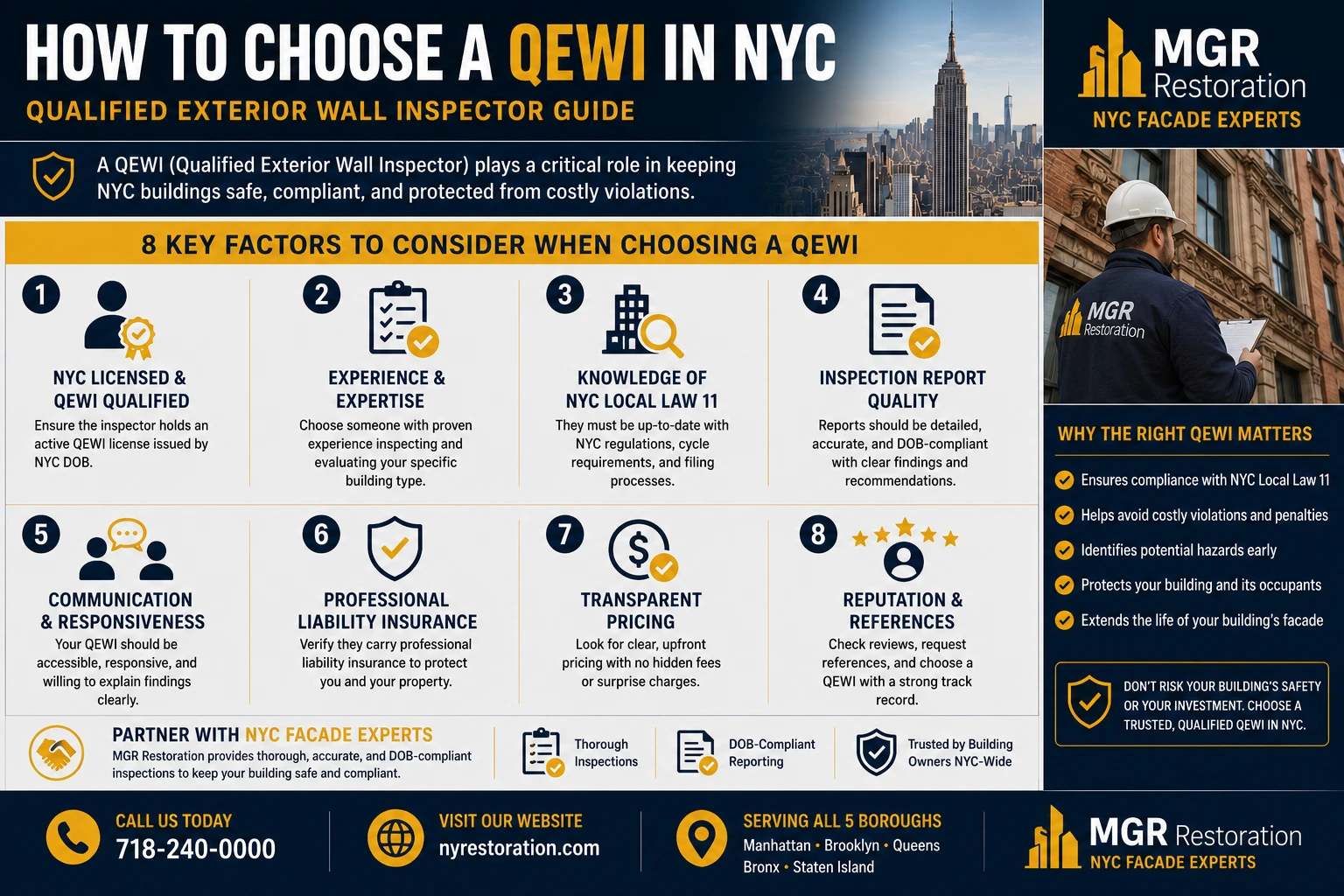
How to Choose the Right QEWI in NYC
Choosing a QEWI is not simply a matter of finding the cheapest option. The quality of the inspection directly affects your building’s safety and your legal compliance. Here is what to look for:
Verify DOB Licensing
Confirm that the professional holds a current New York State PE or RA license and is registered with the NYC DOB as a QEWI. You can verify licenses through the NYS Office of the Professions and check DOB registration through the DOB NOW system.
Look for Relevant Experience
Ask specifically about their experience with your building type. A QEWI who specializes in modern curtain wall systems may not be the best choice for a pre-war brownstone or a terracotta-clad loft building. Look for experience with:
- The era of your building (pre-war, mid-century, modern)
- The primary facade material (brick, stone, terracotta, concrete, stucco)
- Buildings of similar height and complexity
Ask About Their Inspection Method
A thorough QEWI will conduct a close-up physical inspection of the entire facade — not just a ground-level observation supplemented by binoculars. Ask directly:
- How will you access the facade for close-up inspection?
- Do you use scaffolding, suspended scaffold, or aerial lifts?
- Will you personally conduct the field inspection, or will you supervise staff?
Check Their FISP Filing History
A QEWI with significant NYC experience will have a track record of successful FISP filings. Ask for references from other NYC building owners or managers, and verify their filing history through the DOB’s public records.
Understand What Is Included in the Fee
QEWI fees vary based on building size, height, facade complexity, and access requirements. Make sure you understand exactly what is included:
- Is scaffolding or suspended scaffold included, or billed separately?
- Does the fee include DOB filing, or is that extra?
- What happens if Unsafe conditions are found — are follow-up inspections included?
Assess Their Communication & Responsiveness
Your QEWI needs to communicate clearly with you about findings, timelines, and any urgent conditions. A professional who is hard to reach or unclear in their reports can create compliance problems and leave you exposed.
Red Flags to Avoid When Hiring a QEWI
Not all QEWI inspections are equal. Watch out for these warning signs:
🚩 Unusually low fees with no explanation A FISP inspection requiring proper close-up access to a large building cannot be done cheaply. Extremely low fees often mean corners are being cut — ground-level observation only, no scaffolding, or a junior staff member doing the work without proper supervision.
🚩 No mention of close-up access If a QEWI does not proactively discuss how they will physically access the facade for close-up inspection, ask directly. Ground-level-only inspections are not compliant with FISP requirements.
🚩 Pressure to file “Safe” without thorough inspection Some building owners — and unfortunately some inspectors — prefer a Safe rating regardless of actual conditions. An inspector who offers to file Safe without conducting a thorough inspection is exposing you to serious liability.
🚩 No professional liability insurance Any licensed professional conducting FISP inspections should carry professional liability (errors and omissions) insurance. Ask for a certificate of insurance before engaging.
🚩 Unable to provide references An experienced QEWI should be able to provide references from NYC building owners or managers for whom they have previously conducted FISP inspections.
🚩 Not familiar with your building type A QEWI who cannot speak knowledgeably about the specific facade materials and conditions common in your building type — whether that is pre-war terracotta, brownstone, mid-century concrete, or modern curtain wall — may not have the relevant expertise.
QEWI vs Repair Contractor — What Is the Difference?
This is one of the most common points of confusion for NYC building owners navigating FISP compliance.
The QEWI is the licensed engineer or architect who conducts the inspection, prepares the report, and files with the DOB. They assess conditions and recommend repairs — but they do not perform the repairs themselves.
The Repair Contractor is the licensed construction contractor who executes the physical repair work identified by the QEWI — repointing mortar, replacing masonry, repairing terracotta, restoring lintels, and so on.
These are two separate roles, and in most cases two separate companies. The QEWI cannot certify their own contractor’s repair work — that would be a conflict of interest.
The typical FISP compliance process:
- QEWI conducts inspection and files report
- If SWARMP or Unsafe: building owner hires a repair contractor
- Repair contractor completes the required work
- QEWI returns to inspect and certify completed repairs
- QEWI files amended report with DOB — closing out the violation
MGR Restoration is a repair contractor — not a QEWI. We work alongside your QEWI inspector to execute the repairs they identify, on time and to the standard required for engineer certification.
Learn more about our Facade Repair & Local Law 11 Repair services
FISP Cycle 9 Deadlines — Is Your Building on Track?
FISP inspections operate on a cycle tied to the last digit of your building’s tax block number. The current cycle is Cycle 9, with sub-cycle filing deadlines staggered across several years.
| Sub-Cycle | Block Numbers Ending In | Filing Deadline |
|---|---|---|
| 9A | 4, 5 | February 21, 2025 |
| 9B | 6, 9 | February 21, 2026 |
| 9C | 0, 3, 7, 8 | February 21, 2027 |
| 9D | 1, 2 | February 21, 2028 |
Always verify current deadlines directly with the NYC Department of Buildings, as dates are subject to change.
If your building missed a prior sub-cycle deadline, you are already accumulating fines. Contact a QEWI — and a repair contractor if needed — as soon as possible to get back into compliance.
💡 Pro Tip: Don’t wait until the deadline is approaching to engage a QEWI. Quality inspectors get booked up in the months before filing deadlines. Start the process 6–12 months before your due date.
What Happens After the FISP Inspection?
If Rated Safe
Your QEWI files the Safe report with the DOB. You are compliant until the next cycle. Maintain your building and schedule your next inspection accordingly.
If Rated SWARMP
Your QEWI files the SWARMP report identifying required repairs. You have until your next filing cycle deadline to complete the repairs and have them certified. Engage a qualified repair contractor promptly — especially if the repair scope is significant.
If Rated Unsafe
- Install a sidewalk shed immediately (within 24 hours of the Unsafe finding)
- Engage a repair contractor immediately
- Complete repairs as quickly as possible
- Have your QEWI certify the completed repairs and file an amended report with the DOB
- Remove the sidewalk shed only after DOB acceptance of the amended filing
Learn more about Sidewalk Shed Installation
How MGR Restoration Works With QEWI Inspectors
MGR Restoration is a full-service exterior restoration contractor — not a QEWI inspection firm. Here is how we fit into the FISP compliance process:
We execute the repairs your QEWI identifies. Whether your building needs brick repointing, terracotta repair, lintel replacement, parapet rebuilding, or stone restoration, we have the expertise and equipment to complete the work to the standard your QEWI requires for certification.
We work on tight timelines. Unsafe violations require immediate action. We respond quickly and can mobilize crews and scaffolding rapidly for urgent situations.
We coordinate directly with your QEWI. We communicate clearly with your inspector throughout the repair process — ensuring our scope of work aligns with their requirements and that there are no surprises at certification.
We handle suspended scaffold installation. For high-rise buildings requiring swing stage access, we install and operate suspended scaffolding systems in compliance with all NYC DOB requirements.
Learn more about our Suspended Scaffold & FISP Inspection support services
If you need a QEWI referral, we work with several experienced, licensed QEWI engineers and can provide referrals to building owners who need help finding a qualified inspector.
Related Services for NYC Building Owners
FAQs
Get Expert FISP Repair Support in NYC
Found out your building has SWARMP or Unsafe conditions? MGR Restoration works alongside your QEWI to execute the required repairs — fast, correctly, and to the certification standard your inspector requires.
📞 Call us: 718-240-0000
🌐 Contact MGR Restoration
🔧 View All Services
📍 48-11 69th Street, Woodside NY 11377 | contact@nyrestoration.com